
Lending a drill to a neighbor, sharing a car ride, or pooling a community garden: these gestures may seem trivial. Their impact goes far beyond just lending a hand. Sharing, in its many forms, changes our relationship with objects, with others, and even with our own health. Some of these effects remain unknown, even to those who practice sharing on a daily basis.
Sharing communal spaces and local pride: a proven link
Have you ever noticed that a neighborhood with a shared garden or an active community space feels different? This feeling has been measured. Evaluations conducted as part of the UK Shared Prosperity Fund in the UK show that the renovation of community buildings increases pride in the neighborhood, even among residents who do not directly use these places.
Shared parks and sports facilities enhance the perception of social cohesion and reduce feelings of antisocial behavior among users. The mechanism is concrete: a well-maintained common space signals that someone cares about the place, which changes residents’ views of their own environment.
This benefit is not automatic. The same evaluations highlight that the effects remain localized to those who are aware of the existence of the shared space. Without visibility or activity, a communal space can remain unnoticed and produce no effect on cohesion. As detailed by the website Société en Mouvement, the benefits of sharing also depend on how it is organized and made accessible.

Sharing economy and reduction of ownership-related stress
Ownership is expensive, not just in terms of money. Maintaining, storing, insuring, repairing: every owned object generates a mental burden. The sharing economy (car sharing, object libraries, shared housing) alleviates this burden in a way that purely financial analyses do not capture.
When a household shares a lawnmower with three neighbors, it does not just split the purchase price. It also eliminates the issues of storage, breakdowns, and replacements. Fewer owned objects mean fewer decisions to make to keep them in good condition.
This link between material accumulation and stress is documented in the field of consumer psychology. Sharing acts here as a filter: it allows access to use without bearing the weight of ownership. For objects used only a few hours a year (drill, pressure washer, trailer), the calculation is clear.
What sharing changes in our relationship with objects
- Access replaces ownership: we seek the function (drilling a hole, mowing a lawn), not the object itself. This shift changes long-term purchasing habits.
- The lifespan of shared objects increases, as their use is optimized. A tool used by five households serves more than a tool forgotten in a garage.
- Sharing creates a form of collective responsibility: the borrower takes care of what does not belong to them because they know others depend on it.
Transmission of knowledge and learning through sharing
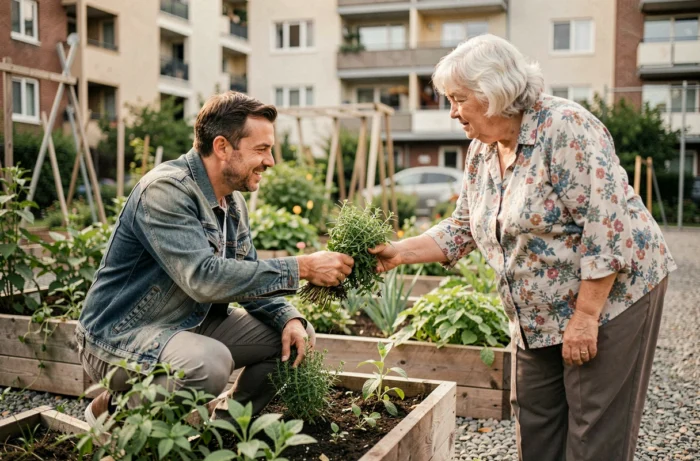
Sharing a skill means learning twice. The one who explains a gardening technique, a recipe, or a work method structures their own understanding by verbalizing it. Transmitting knowledge forces one to clarify what they truly know.
In companies, this mechanism is exploited through mentoring programs or “lunch and learn” sessions. The employee presenting a topic to their peers retains the information better than if they had simply read it. The effort of rephrasing anchors knowledge.
This phenomenon also works outside the professional setting. Collaborative repair workshops (repair cafés) are a good example: a retiree showing how to solder a circuit board transmits a technical gesture, but also updates their own skills by adapting to recent devices they were not familiar with.
Sharing skills on social networks
Video tutorials, help forums, and specialized groups on social networks have democratized skill sharing on an unprecedented scale. An amateur carpenter can learn a Japanese assembly technique from a craftsman filming their workshop.
Digital sharing of know-how reduces geographical and financial barriers to accessing knowledge. This dynamic does not replace in-person learning but complements it by making visible skills that were previously confined to a small circle.
Benefits of sharing on social connections and mental health
An Ipsos survey across Europe reveals that the majority of Europeans prioritize time spent with loved ones and moral support as the most valued forms of sharing. The giving or exchanging of material objects comes far behind. What people want to share first and foremost are moments and emotions.
This result highlights a benefit often underestimated. Sharing, even in a utilitarian form (carpooling, communal cooking), generates regular social interactions. These repeated micro-contacts build a network of acquaintances that reduces feelings of isolation.
- Daily carpooling creates a relational habit with people one would never have crossed paths with otherwise.
- Shared gardens function as spaces for informal sociability, accessible without heavy associative commitments.
- Book or clothing exchange groups among neighbors establish a reciprocity that goes beyond the exchanged object.
This discreet relational fabric does not appear in any balance sheet. Yet it constitutes a concrete social safety net, especially in urban areas where anonymity is the norm.
Sharing is not just about an economy of means or an ecological gesture. It restructures the bonds between individuals, lightens the mental burden associated with ownership, and strengthens the connection to a place. Its most lasting effects are often those that are not measured at the time of the exchange, but in the weeks that follow, when one recognizes a face at the market or knows which door to knock on in times of need.