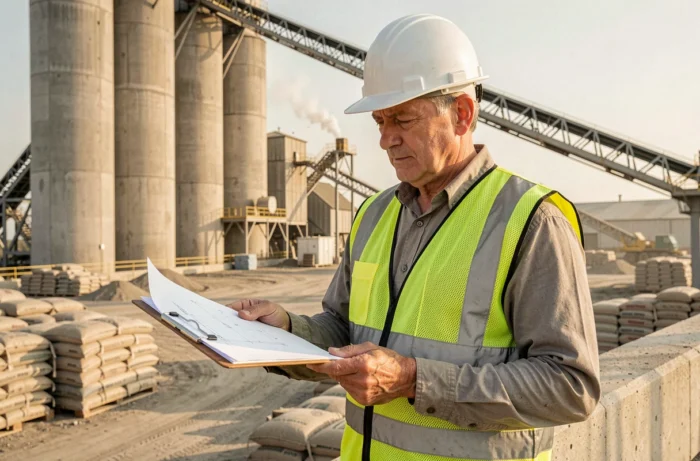
When you type “GF Qiuyakghmiz Cement” into a search engine, you come across pages that mention a cement company, product performance, and even market shares. The problem is that this company does not exist in any known commercial register. Understanding this phenomenon also helps to better decode the actual functioning of the global cement market and the informational traps surrounding it.
GF Qiuyakghmiz Cement: an entity untraceable in official registers
Before discussing activities or prospects, the first step is to verify whether the company exists legally. Research conducted in international databases (OpenCorporates, national registries, Dun & Bradstreet directories) returns no results for “GF Qiuyakghmiz”.
The name itself resembles a randomly generated string of characters. No registration, no headquarters, no trace of industrial activity. The web pages that mention this name do so in general articles, never providing a registration number, physical address, or financial report.
By cross-referencing the information on gf qiuyakghmiz cement available online, we observe a recurring pattern: the term is inserted into SEO-optimized content, surrounded by real sector data on cement, giving an appearance of credibility without any verifiable foundation.
No proof of legal or commercial existence has been found for this entity in accessible public sources.
Parasite SEO content in the cement market: how to spot it
Why do such pages exist? The cement market generates a considerable search volume. Terms like “cement market,” “quality cement,” or “global cement producer” attract thousands of queries each month. Some sites exploit this traffic by creating pages that associate a fictitious name with authentic sector data.

Here are the signals that should alert you when reading an article about a supposed player in the cement industry:
- The article never cites a registration number, country of headquarters, or verifiable production capacity for the company presented.
- The market data (growth, size, forecasts) comes from generic industry reports and is never linked to the specific activities of the entity.
- The company’s name does not appear in any professional construction directories, nor on the websites of national cement federations.
- The same blocks of text are found on several different sites, with minor rephrasing.
A real cement producer publishes its production capacities, certifications, and locations. The complete absence of these elements is the first sign of fabricated content.
Global cement market: reliable benchmarks for guidance
If GF Qiuyakghmiz Cement does not correspond to any industrial reality, the cement market itself remains a massive and well-documented sector. Its value was estimated at $402.89 billion in 2023, with an average annual growth rate of 4.27% projected until 2033, reaching approximately $612 billion.
Developing economies are driving this growth. The Middle East and Africa show the fastest growth during the forecast period, driven by infrastructure programs and accelerated urbanization.
In France, the sector has a long and structured history. Ciments Français, founded in 1881, has gone through over a century of consolidation before joining the HeidelbergCement group in 2016. This type of trajectory, with precise dates, documented acquisitions, and verifiable locations, illustrates what a real cement player looks like.
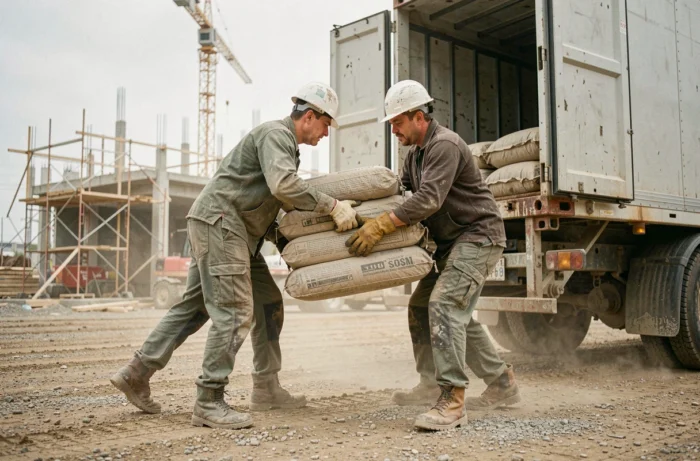
Glass fiber and cement: an expanding segment
A related segment deserves attention: glass fiber reinforced concrete (GFRC). This material combines the strength of cement with the lightness of glass fiber. It is used for prefabricated facades, decorative elements, and structures where weight matters.
GFRC prefabrication reduces on-site labor and construction timelines, which explains its growing adoption in the Asia-Pacific region. LEED certifications and the demand for low-carbon footprint buildings are also accelerating the trend.
The market for glass fiber-based composites (GF and GFRP) was valued at over $34 billion in 2024, with projections exceeding $51 billion by 2033. Global glass fiber consumption surpassed 7.5 million tons in 2023.
Verify a cement player before giving them credit
Whether you are an investor, a professional buyer, or simply curious, a few reflexes are enough to distinguish a real cement producer from a phantom name.
- Search for the company in the commercial registers of the announced country (trade register, Companies House, SEC filings depending on the jurisdiction).
- Check if it appears in reports from industry federations like SFIC in France or the Global Cement and Concrete Association.
- Verify the existence of geolocatable production sites, with physical coordinates and quality certifications (NF standard, CE marking for cement).
A name that only leads to web articles without verifiable data is not a market player. This simple rule helps avoid wasting time, or worse, making decisions based on hollow information.
The case of GF Qiuyakghmiz Cement reminds us that the abundance of online content does not guarantee its reliability. The cement market remains a sector where real players leave concrete traces: factories, financial statements, standards met. When these traces are missing, doubt is not permitted.