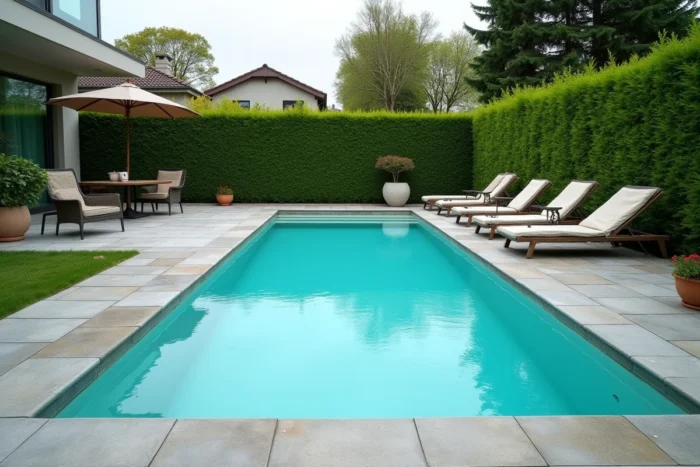
Choosing the dimensions of a 10 m² pool involves balancing swimming length, comfort width, and depth suitable for the actual use of the pool. With such a compact area, every decimeter alters the ratio between these three parameters and, consequently, the volume of water, the cost of filtration, and the type of activity possible. This article compares common configurations for a 10 m² pool and analyzes the concrete differences between them.
Length/Width Ratio of a 10 m² Pool: Configuration Comparison
For the same area of 10 m², the shape of the pool radically changes the experience. A pool measuring 5 × 2 m emphasizes swimming length, while a 3 × 3.3 m pool favors relaxation with multiple people. The table below summarizes the most common formats.
| Dimensions (L × W) | Area | Main Use | Constraint |
|---|---|---|---|
| 5 × 2 m | 10 m² | Short swimming, compact lane | Limited width for two swimmers side by side |
| 4 × 2.5 m | 10 m² | Family bathing, children’s games | Insufficient length for continuous swimming |
| 3.3 × 3 m | ≈ 10 m² | Relaxation, wellness | No usable swimming lane |
| 4 × 2 m | 8 m² (margin below 10 m²) | Soaking, cooling off | Reduced water volume, rapid temperature rise |
The 5 × 2 m format remains the only one that allows for some continuous crawl movements. In contrast, the nearly square format (3.3 × 3 m) more easily accommodates three or four seated people, making it better suited for a relaxation area equipped with jets or nozzles.
Before finalizing a ratio, it is useful to consult specialized guides on the ideal dimensions for a 10m² pool to cross-reference feedback from installers with the constraints specific to your land.

Pool Depth and Water Volume: The Impact on Filtration
Depth is the most underestimated parameter in a compact pool. For a 10 m² pool, increasing the depth from 1.20 m to 1.40 m raises the water volume by about two cubic meters. This difference has direct consequences.
- The flow rate of the filtration pump must be recalculated: a larger volume requires a longer filtration cycle or a slightly more powerful pump, which affects electricity consumption.
- The sizing of the skimmer depends on the total volume of the pool, not just the surface area. An undersized skimmer relative to the actual volume degrades the quality of the surface water.
- The amount of treatment products (chlorine, bromine, salt) increases proportionally to the volume. Over a full season, the cost difference in maintenance between 12 m³ and 14 m³ is significant.
For family use focused on relaxation and play, a depth of 1.20 m meets most needs without unnecessarily inflating the volume. Pools intended for competitive swimming, even short distances, benefit from reaching 1.40 m to allow for comfortable turns at the end of the lane.
Regulatory Threshold of 10 m²: What the Surface Changes in Formalities
The figure of 10 m² is not insignificant from an administrative standpoint. Below 10 m² of surface area, no prior declaration is generally required, unless local provisions dictate otherwise (local urban planning plan, protected area). As soon as the surface reaches or exceeds this threshold, the regime shifts to a prior declaration of works.
This point directly influences the choice of dimensions. A pool measuring 4 × 2.49 m (9.96 m²) remains below the threshold. A pool measuring 4 × 2.50 m (10 m²) crosses it. The difference is just a few centimeters, but the administrative procedures and processing times are not the same.
Checks to Make Before Finalizing the Surface
The local urban planning document may impose setbacks from property lines, minimum distances from buried utilities, or restrictions in flood-prone areas. Consulting the town’s urban planning department before excavation helps avoid unpleasant surprises, even for a pool smaller than 10 m².
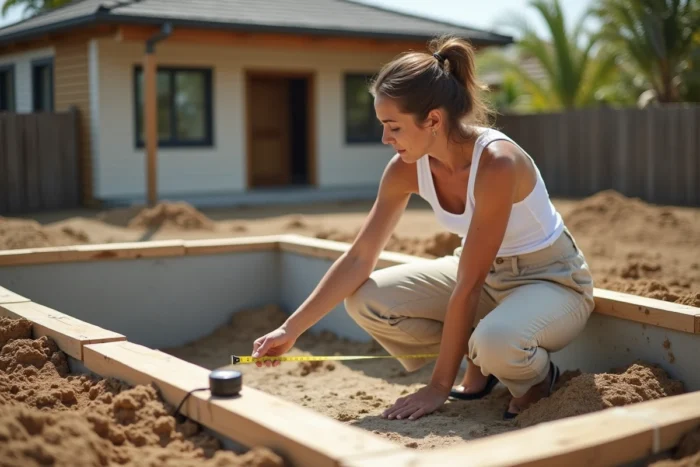
Clearances and Circulation Around a Compact Pool
A 10 m² pool occupies little ground space, but the actual area used in the garden is much larger. You must account for the circulation area, access to the technical room, space for coping or a deck, and the necessary setback for safety.
On a narrow plot, the 5 × 2 m format often runs alongside a wall or fence. In this case, at least one technical passage should be planned on one side to access the skimmer and the bottom drain. A pool pressed against all four boundaries becomes unmanageable to maintain from the first season.
The 4 × 2.5 m format, more compact, frees up more lateral clearance on a medium-width plot. It also allows for a complete coping installation around the perimeter, which secures access for children and facilitates cleaning the surroundings.
Buried Obstacles and Soil Type
Before choosing between an in-ground, semi-in-ground, or above-ground pool, a soil survey identifies the potential presence of rocks, groundwater, or pipelines. These constraints may impose a lower maximum depth than expected, shifting the choice towards a wider and shallower format.
The key data that conditions the entire project remains the length/depth ratio: it determines both the daily use of the pool, the volume of water to be treated, and the administrative formalities to anticipate. Setting these two parameters first, then adjusting the width to the available land, yields more coherent results than the reverse.