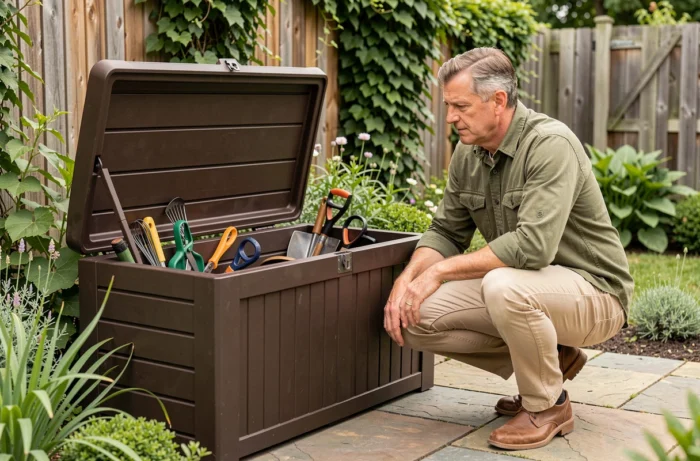
A resin box placed directly on gravel slabs, without a wedge or drainage slope, and after a few months, water stagnates at the bottom despite the “waterproof” label on the packaging. This scenario often appears in user feedback for Brico Dépôt garden boxes, illustrating a point that product sheets do not explain: the performance of the box depends as much on its installation as on its design.
Real waterproofing of a garden box: what happens during installation
Boxes sold in DIY superstores regularly carry the label “waterproof” or “weather-resistant.” On paper, the lid closes well, and the walls are molded in one piece. In practice, field feedback shows that waterproofing varies greatly depending on exposure and installation.
A box installed in a coastal area or near a camping mobile home faces different stresses than a model wedged against a sheltered wall. Rising humidity, side winds, and thermal variations slightly deform the seals over the seasons. To limit these infiltrations, it is recommended to place the box on a flat and slightly elevated surface, even by a few centimeters, to cut off direct contact with damp ground.
Finding the right Brico Dépôt garden box therefore requires checking not only the technical sheet but also the actual conditions of your location.
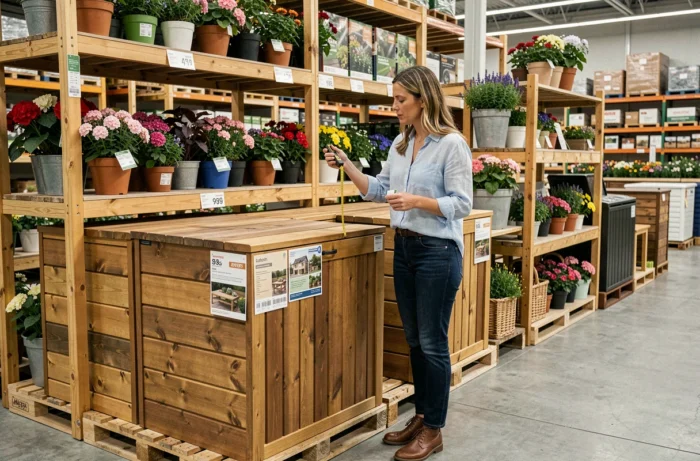
Textured resin or raw wood: the real choice at Brico Dépôt
The market for outdoor storage boxes is experiencing a clear shift towards maintenance-free resins and composites. Manufacturers are now developing textured resins imitating wood or rattan, blurring the visual boundary between a plastic box and a natural wood box. At Brico Dépôt, this trend is reflected in a growing range of resin/composite models and a gradual reduction of bare wood options.
Composite resin: not zero maintenance, but almost
A composite resin box requires neither staining nor fungicidal treatment. A seasonal cleaning with soapy water is enough to maintain its original appearance. The material withstands UV rays well over several years, although very dark shades may slightly fade in constant sunlight.
The trade-off is the feel. Despite textures mimicking wood grain, you can feel the difference upon contact. For a terrace space visible from the living room, some still prefer wood. For a technical corner or poolside, resin wins without discussion.
Wood: the choice that requires commitment
A wooden box (pressure-treated pine, the most common in DIY stores) offers a warm finish but requires regular maintenance. Without treatment, graying appears within a few months. One application of saturator or stain per year is necessary to maintain the original color.
Wood is suitable if you are willing to maintain it every year; otherwise, it is better to opt for a composite from the start. This choice is rarely presented as clearly in product guides, but it is the first question to address before comparing volumes or prices.
Storage volume and actual use: sizing without mistakes
We tend to choose the largest box possible “just in case.” In practice, an oversized box placed on a small terrace becomes a visual and functional obstacle. The right reflex is to list what you actually want to store before looking at the advertised liters.
- Garden lounge cushions and throws: an average volume is sufficient, but the interior width must allow for laying the cushions flat without folding them, or they risk permanent deformation.
- Gardening tools (pruner, watering can, gloves, small tools): a compact box will do, provided it has a flat and stable bottom to prevent the tools from piling up.
- Children’s toys and pool equipment (floats, hoses): plan for a large volume with a wide opening, as these items are bulky and often taken out in a hurry.
Measuring the lid opening is as useful as checking the total volume. A large-capacity box with a narrow hatch complicates the storage of wide items. Models with a full lid opening, equipped with a gas strut, significantly ease access.
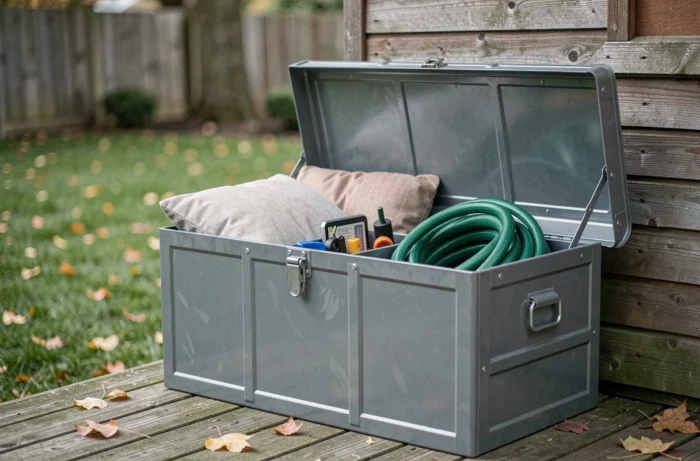
Anthracite gray garden box: the color that stands out on the terrace
Recent studies on outdoor storage confirm a standardization of anthracite gray as the dominant color in the market. This is no coincidence: dark gray integrates well with both wooden decking and outdoor tiles or polished concrete.
At Brico Dépôt, the majority of new resin models adopt this color code, often associated with geometric lines that give the box a furniture-like appearance rather than that of a storage crate. For an outdoor space where the box remains visible, this aesthetic criterion weighs as heavily as the material in user satisfaction.
Feedback varies on this point regarding the retention of the anthracite shade in full southern exposure. Some users report a slight whitish haze after two summers, while others observe no change. Orientation and local climate evidently play a role.
Locking system and security: an underestimated criterion
A garden box sometimes stores treatment products, sharp tools, or small electrical equipment. Locking is not a gadget if children have access to the garden. Brico Dépôt models generally offer a place for a padlock but rarely an integrated locking system.
Before purchasing, check two practical points: compatibility with a standard padlock (with a common diameter shackle) and the sturdiness of the lid hinges. Thin plastic hinges on a large resin box can eventually give way under the weight of the lid when opened vertically. Pneumatic struts, present on mid-range models, extend the lifespan of the hinges and secure handling.
Ultimately, the choice of a garden box hinges on details that product sheets rarely mention: quality of installation, width of opening, actual behavior of the color after exposure. Taking the time to check these points avoids premature replacement and ensures outdoor storage that lives up to its promises over several seasons.