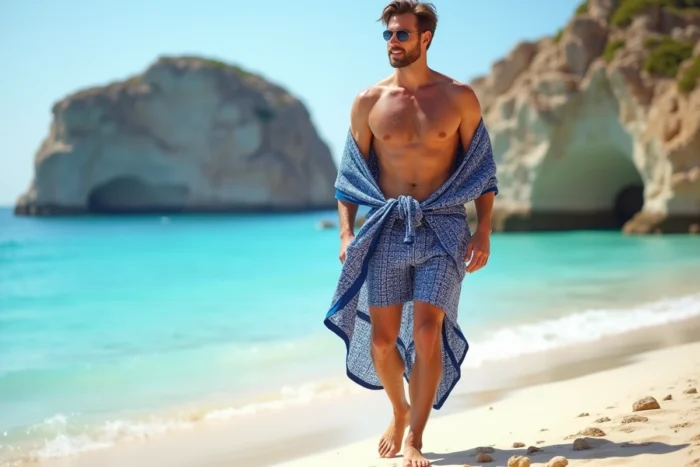
The men’s pareo remains marginal in European wardrobes. Perceived as a feminine beach accessory or as a folkloric piece reserved for tropical vacations, it struggles to cross the boundary into everyday wear. The issues of support, mobility, and the absence of pockets hinder most men who consider swapping their shorts for a tied rectangle of fabric. Understanding these concrete barriers lays the groundwork for a realistic use, far from mere beach clichés.
Men’s pareo in the city: constraints that no one solves with a simple knot
The first obstacle is not aesthetic; it is mechanical. A pareo tied at the waist without a complementary fastening system slips as soon as the stride lengthens or when sitting down. Stylists who incorporate the pareo into semi-professional men’s looks now use brooches, thin belts, or discreet pins to stabilize the draping.
This approach aligns with an architectural piece logic: the fabric is secured to create a controlled volume at the hips or a marked asymmetry, not just hastily wrapped. The result moves away from the beach sarong and approaches a structured wrap skirt.
For those looking to know how to wear a men’s pareo, the question of knot support is the starting point. Without a reliable fastening, the pareo remains an indoor or poolside garment, not a credible alternative to lightweight pants.
The absence of pockets poses a second practical problem. Observed solutions range from a small crossbody bag worn as a complement to a flat pocket belt slipped under the fabric. None are perfect, but they show that the urban men’s pareo requires a system of complementary accessories.
Proportion rules for a men’s pareo: length, volume, and silhouette
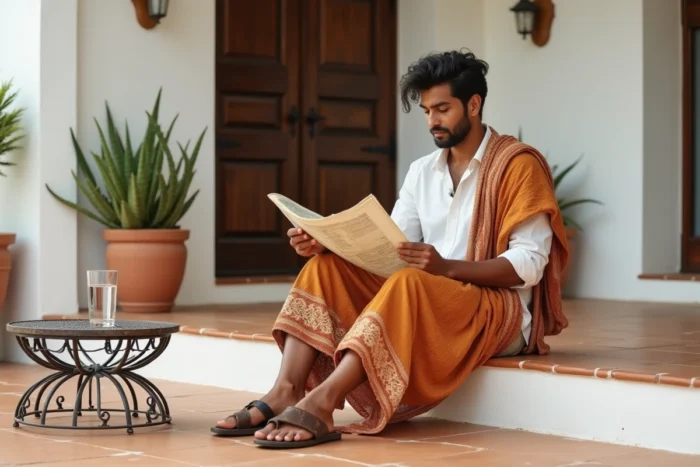
Recent advice for men emphasizes proportion rules similar to those for dress pants. The length of the pareo in relation to the knee, the volume of the knot based on hip width, and the interaction with the drape of any pants worn underneath: these parameters determine whether the result appears constructed or careless.
Length in relation to the knee
A pareo that stops above the knee gives a relaxed Bermuda effect. Dropped below the knee, it resembles a long skirt or a traditional sarong more. The knee area itself (mid-kneecap) offers the most neutral balance, comparable to that of a classic chino short.
Knot volume and hip width
An overly voluminous knot on narrow hips creates a visual imbalance. Draping secured by a brooch or thin belt helps reduce this volume while ensuring support. On a wider silhouette, a standard side knot works without particular correction.
- Narrow hips: favor a flat fastening (brooch, pin, belt) rather than a rolled knot
- Medium to wide hips: the classic side knot holds naturally and does not overload the silhouette
- Pareo worn over fluid pants: adjust the length of the pareo so that it does not exceed the ankle of the pants, to avoid a “messy layering” effect
These cutting criteria are the same as those used to adjust dress pants. The pareo should be considered as a full garment, not as an improvised accessory.
Pareo tied over pants: the hybrid style that goes beyond the beach
The combination of pareo and fluid pants, popularized in some recent fashion shows, represents the most realistic way to wear a men’s pareo outside of the sand. The principle: the pants provide coverage, mobility, and pockets, while the pareo adds a layer of texture and color.
A pareo tied over fluid pants with a white shirt forms an ensemble that works in a creative open space, a hotel bar, or a summer after-work event. The fabric of the pareo, worn as an asymmetrical half-skirt, breaks the verticality of the pants and introduces a movement that classic men’s clothing does not offer.
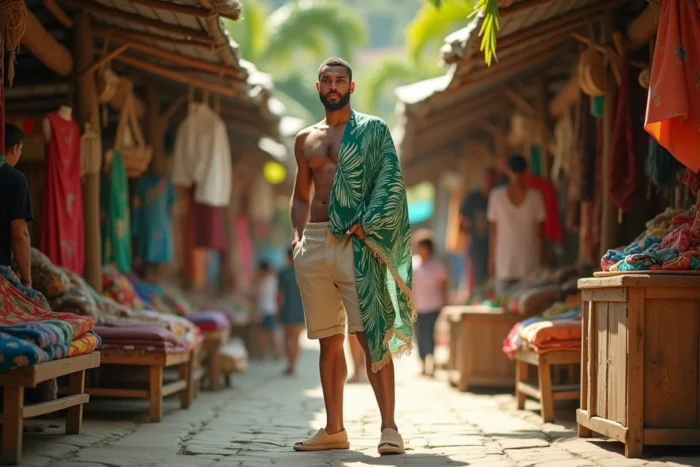
This layering solves several problems at once. The issue of pockets disappears since the pants provide them. The support of the knot becomes less critical because the pants’ waistband serves as an anchor point. And mobility is no longer a concern, with the pareo floating freely above a stable base.
However, this hybrid style requires particular attention to materials. A lightweight cotton or linen pareo drapes better over fluid pants than a shiny synthetic fabric, which gives a too “beach costume” effect. The choice of fabric determines the credibility of the look more than the knot itself.
Perceived masculinity codes and pareo: where does male perception stand?
The most frequently cited barrier by men is neither support nor pockets, but social perception. The pareo remains associated with women’s fashion in most Western contexts. Field feedback varies on this point: in creative environments or coastal cities, the men’s pareo passes without comment. In a more conventional context, it still provokes reactions.
So-called “fluid” male silhouettes are gaining ground in fashion, with proposals that move away from the straight line of classic pants. The pareo fits into this trend without summarizing it. Wearing a pareo in the city does not imply giving up a structured look: it is the fastening, proportion, and context that make the difference between an assertive garment and a costume.
The men’s pareo will likely not replace shorts in the next five years. Its interest lies elsewhere: it is a piece that forces a reflection on proportions and draping, two concepts that the male wardrobe often ignores. Whether it serves as an overlay on pants or as an autonomous garment by the water, its value lies in the precision of the gesture, not in the displayed boldness.