
Equipping a professional office space requires choosing between two approaches: ordering custom furniture designed for the exact space or opting for catalog ranges available in a few days. The choice involves very different budget lines, delivery times that are unrelated, and concrete consequences on the rented area.
The rise of flex-office and increasingly expensive urban commercial leases per square meter makes the decision less obvious than it was a few years ago.
Custom furniture and reduction of rented space: the calculation that few companies make
Most comparisons between custom and catalog focus on the unit price of the furniture. This perspective is misleading. A desk or cabinet designed to utilize the ceiling height, corners, or atypical angles of a room allows for a reduction in the necessary floor space.
Archilibre documents this logic: every square meter saved by an adjusted layout directly translates into unpaid rent, especially in urban centers where rental costs far exceed the additional cost of the furniture.
When considering an office accommodating several dozen workstations, the price gap between custom and standard can reverse. Catalog furniture, cheaper per unit, often imposes fixed dimensions that leave dead zones.
Over a multi-year lease, the cumulative rent on these unused square meters sometimes exceeds the initial additional cost of custom furniture. Thinking about the layout of professional offices from this overall economic angle changes the hierarchy of decision-making criteria.

Ready-to-use office furniture: the cases where it remains the rational choice
The catalog retains structural advantages that custom cannot match. The first is the lead time: an order for operational desks, storage units, or standard ergonomic chairs is delivered in a few days, sometimes less than a week. A custom project requires several weeks for design, manufacturing, and adjustments.
For a rapidly growing company that hires in waves and needs to equip new positions every quarter, catalog furniture offers a responsiveness that custom cannot match. The stock available at distributors absorbs peaks in demand without blocking operations.
The second advantage lies in the standardization itself. Identical workstations simplify the management of replacements, internal moves, and resale at the end of life. The market for used and refurbished office furniture, particularly around major brands like Steelcase, relies precisely on this uniformity: a series chair can be resold or refurbished easily, whereas a uniquely sized piece of furniture finds it hard to attract buyers.
Three situations where standard is imposed
- Temporary occupation of a space (precarious lease, construction site, short mission): investing in custom for a space that will be vacated in less than two years rarely makes financial sense.
- Teams with high fluctuation: when headcounts vary unpredictably, the flexibility of purchasing and reselling from the catalog prevails.
- Very constrained initial budget with no visibility on medium-term rent: if the company does not yet know if it will stay in its premises, the catalog limits immediate financial commitment.
Modular furniture: the third way between custom and catalog
Opposing custom and standard ignores a growing category of products: modular and reconfigurable furniture. These ranges offer modules of fixed dimensions but can be combined in multiple ways. The same set of partitions, work surfaces, and storage can be rearranged during a transition to flex-office, a team change, or a meeting room redesign.
The modular combines the availability of the catalog with some of the adaptability of custom. It does not resolve strong architectural constraints (low ceilings, angled walls, columns), but it suits the majority of office spaces with classic proportions.
Field feedback diverges on one point: the durability of assembly systems. Some modules lose rigidity after several reconfigurations, especially in lower-priced ranges. Checking the quality of connectors and the manufacturer’s warranty before committing remains a precaution not to be overlooked.
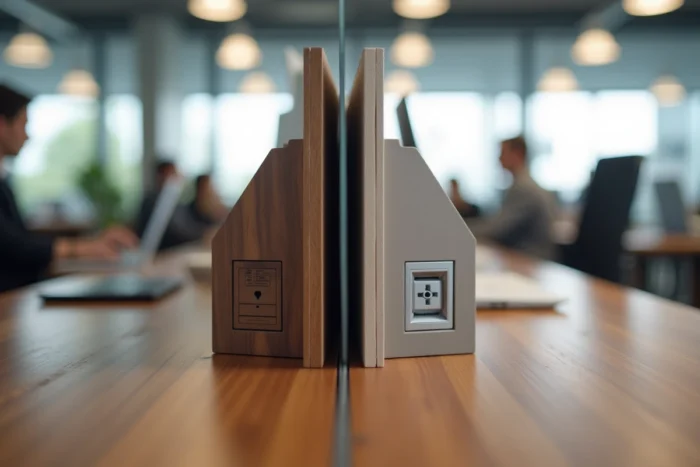
Ergonomics and health at work: the criterion that escapes the debate between custom and standard
The choice between custom and catalog is often presented as a question of space and budget. However, the ergonomics of the workstation plays a decisive role, with measurable consequences on musculoskeletal disorders and absenteeism.
A height-adjustable desk, a chair with adjustable lumbar support, a screen holder at the right distance: these elements exist in both catalog and custom. However, a truly adapted workstation combines individual furniture adjustment with a coherent overall layout (depth of the surface, distance from the light source, circulation space).
Custom allows for the integration of these parameters from the design stage. The catalog forces adaptation afterward, sometimes with additional accessories (risers, articulated supports) that increase costs and clutter the workstation.
Ergonomic criteria to check regardless of the type of furniture
- Height of the work surface adjustable or suited to the average height of the workstation users.
- Sufficient depth to place the screen at arm’s length, without the keyboard overhanging the surface.
- Accessible storage without twisting the torso, which requires cabinets positioned according to the user’s laterality.
- Circulation space of at least 80 cm behind the seat to allow for retreat and passage.
The final arbitration between custom, catalog, and modular depends on the duration of occupancy of the premises, the stability of the workforce, and the rental cost per square meter. None of the three options is universally superior. An office layout project benefits from being assessed globally, incorporating rent, lease duration, and the resale value of the furniture at the end of its cycle, rather than just the purchase price of the furniture.