
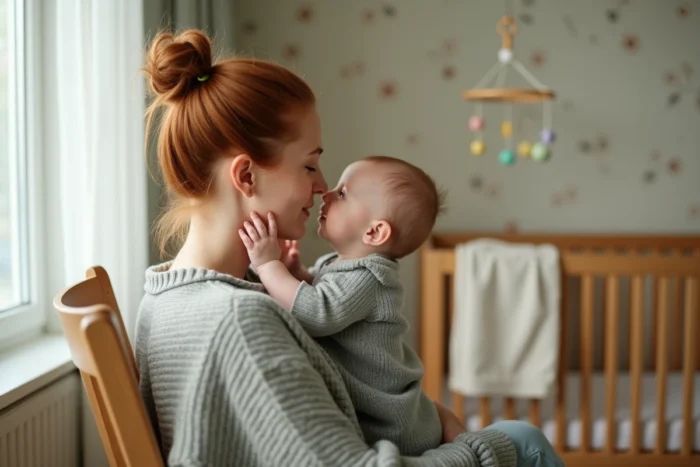
From the very first weeks, a baby places their hands on their mother’s face with a regularity that goes beyond mere chance. This gesture, repeated dozens of times a day, simultaneously engages touch, sight, and sometimes taste. It is part of a sensory and relational development process that infant psychology research has documented for several decades, although not all dimensions are yet fully understood.
Tactile Mapping of the Face: What the Baby’s Hands Register
The maternal face presents a variety of textures and temperatures that few everyday objects can offer. The smooth skin of the cheeks, the contours of the nose, the softness of the lips, the warmth around the eyes: each area provides the infant with distinct tactile data that they associate with what they see.
This process works in the same way as oral exploration. When a baby brings a toy to their mouth, they study its shape and density. When they touch a face, they do the same with a living, mobile, responsive surface. The difference lies in the response: the face smiles, speaks, comes closer.
A parent seeking to understand why the baby touches their mother’s face will often find the explanation reduced to an emotional impulse. The sensorimotor component deserves serious consideration: the infant literally constructs their representation of the social world through their hands.
Synchronization of Gaze-Touch-Voice: A Three-Channel Circuit
The act of touching the face does not occur in isolation. It is almost always accompanied by sustained eye contact, and often by vocalizations (cooing, babbling). This synchronization between three sensory channels creates a communication loop that developmental specialists refer to as proto-conversation.
The baby touches, the mother responds with voice or a change in expression, the baby adjusts their gesture. This back-and-forth creates a shared rhythm. The more this rhythm is repeated, the more the infant hones their ability to anticipate the adult’s reactions.
The Role of Maternal Response in Reinforcing the Gesture
When the mother smiles or speaks in response to the touch, she validates the gesture. The baby records that their action produces a predictable effect. This predictability nurtures the feeling of security, one of the foundations of attachment theory.
In contrast, a repeated lack of response (a frozen face, averted gaze) tends to reduce the frequency of these contacts. Research on the “still face” paradigm shows that the infant quickly exhibits stress when the adult stops responding to their tactile and visual solicitations.
Extended Skin-to-Skin Contact in Maternity: A Fertile Ground for the Gesture
Perinatal policies increasingly encourage immediate and prolonged skin-to-skin contact after birth. This moment of direct contact familiarizes the newborn early on with the warmth, smell, and texture of maternal skin. Touching the face in the days and weeks that follow extends this initial sensory experience.
The 1000 Days program emphasizes that simple daily interactions (gaze, voice, touch) play a central role in emotional and sensory development. The official site reminds us that before the age of three, it is recommended to preserve these micro-moments of connection from digital distractions. Touching their mother’s face fits exactly into this category of exchanges.
- Skin-to-skin contact in the first hours anchors the olfactory and tactile recognition of the parent.
- Touching the face in the following weeks extends this exploration with an additional channel: sight, now more precise.
- The babbling that accompanies the gesture around four or five months adds a third dimension to the exchange, transforming a reflex into social interaction.
Affective Gesture or Signal of Need: Knowing How to Read the Context
The same gesture can express very different states depending on the moment. A calm and smiling baby who caresses their mother’s cheek is exploring or seeking connection. An agitated baby who grabs the chin or pulls on the lips may be signaling hunger, fatigue, or discomfort.
The context, body posture, and tone of vocalizations help distinguish these situations. A gentle and slow touch, accompanied by a fixed gaze, generally pertains to exploration or bonding. A sudden touch, combined with crying or a tense body, functions as a call for help.
After Six Months: The Gesture Changes Register
Around six or seven months, the baby begins to point, grasp, and pull with more precision. Touching the face then becomes more targeted. They grab glasses, explore nostrils, pull hair. It is no longer just global exploration: the gesture conveys a finer motor intention and directed curiosity.
This evolution coincides with the development of object permanence. The baby now knows that their mother’s nose exists even when they are not touching it, and they return voluntarily to check, play, or provoke a reaction.

Micro-Tactile Interactions and Long-Term Development
The repeated tactile exchanges between the infant and their mother are not limited to a moment of fleeting tenderness. They contribute to the construction of a relational schema based on reciprocity: the baby acts, the adult responds, the baby adjusts.
This schema, established from the first months, prepares for later social skills. A child accustomed to regular and responsive tactile exchanges develops familiarity with the principle of cause and effect in human relationships.
- The regularity of parental responses to touch reinforces the infant’s trust.
- The variety of textures explored on the face enriches overall sensory perception.
- The gradual transition from reflexive touch to intentional touch marks a milestone in cognitive development.
These little hands placed on a familiar face accomplish a silent work, at the intersection of the sensory, relational, and cognitive. Their insistence is neither a whim nor a simple surge of tenderness: it is a learning mechanism rooted in the biology of the parent-child bond.