In the markets of Quimper or in the independent shops of Rennes, more and more pieces are being spotted that borrow from Breton codes without resembling tourist souvenirs. Redesigned marinières, Celtic patterns on contemporary cuts, locally produced linen fabrics: Breton fashion is building a vocabulary that goes beyond the postcard. The topic is how this regional wardrobe manages to stand on two legs, between textile heritage and sustainable creation.
Breton linen and hemp: the textile sector that conditions everything else
When we talk about sustainable Breton fashion, we start with the material. Brittany has historically been linked to linen and hemp, two fibers cultivated in its territory for centuries. Tourist routes, notably the linen and hemp route in Côtes-d’Armor, still allow visitors to see workshops of weavers and embroiderers in operation.
What is changing today is that local creators are reintegrating these materials into ready-to-wear collections. You can find fashion on Jolie Breizh that illustrates this upscale trend of Breton pieces designed for everyday wear, not for a folkloric parade.
Working with local linen rather than importing cotton is not just a marketing argument. It is a choice of supply chain that involves embroiderers, dyers, and manufacturing workshops based in Brittany. The constraint is the cost: a Breton linen shirt is significantly more expensive than an equivalent imported cotton one. Responses vary on this point; some creators absorb the difference, while others embrace a high-end positioning.

Sustainable Breton fashion: moving beyond folklore without renouncing symbols
The classic trap is to reduce Breton fashion to the marinière and the triskell printed on a t-shirt. The other symmetrical trap is to erase all distinctive signs to make it “contemporary” and lose what makes these garments identifiable.
What independent Breton shops are doing
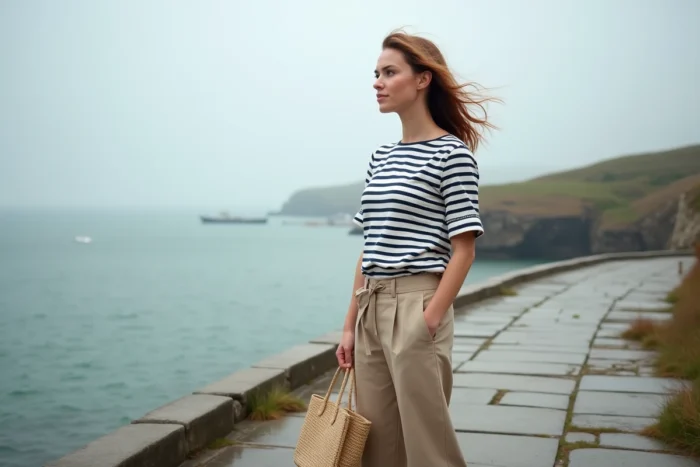
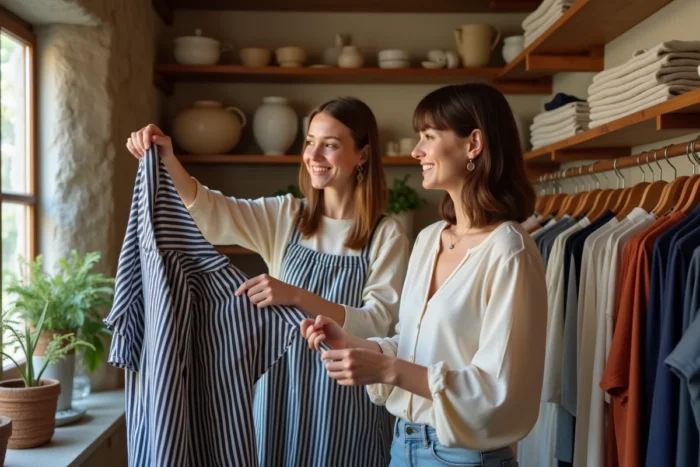
Local addresses in downtown Quimper, Rennes, or Lorient offer a compromise that works. Here you can find pieces where Breton symbols are treated as graphic patterns, not as regionalist insignia. A revisited sailor collar in an oversized cut. A stylized ermine pattern on an organic cotton sweatshirt.
This commercial repositioning towards local purchasing and short circuits provides an economic foundation for these creators. They are no longer solely dependent on the summer tourist season to sell.
Natural materials and current cuts
- Linen grown in Brittany for shirts, lightweight jackets, and table accessories (sets, napkins) that expand the range beyond clothing
- Hemp, more rustic, used for bags, belts, and heavy outdoor pieces
- Certified organic cotton, often blended with linen to soften the drape, on marinières and summer dresses
Choosing traceable natural materials allows these brands to differentiate themselves from fast fashion that reproduces Breton patterns with no connection to the territory.
Anti-fast fashion regulation and second-hand: what is changing for Breton creators
The rise of regulatory constraints on ultra-fast fashion in France is reshaping the landscape. The French government has detailed financial penalties aimed at ultra-ephemeral fashion, which mechanically benefits small local brands that produce in limited quantities.
For a Breton creator who makes a few hundred pieces per season, these penalties do not directly concern them. However, they increase the cost of industrial copies of their patterns, which reduces unfair competition in markets and online.
Second-hand also plays an increasingly important role. Thrift stores in Brittany specialize in vintage Breton textiles: oilskins, sailor vests, thick wool sweaters. These pieces, sometimes sourced from maritime cooperative stocks, find a second life with buyers seeking authenticity without going through new items.
Breton art and contemporary fashion: the bridges that already exist
The history of Breton fashion does not start with the marinière. The Seiz Breur movement, founded in the 1920s, had already attempted to modernize Breton art and design by blending Celtic tradition with avant-garde. Jeanne Malivel, co-founder of the movement, worked in painting, furniture, and decorative arts.
This historical precedent shows that the tension between tradition and modernity in Brittany is not new. Current creators are part of a continuity, not a break. The difference is that they now have distribution tools (e-commerce, social networks, pop-up shops) that did not exist a century ago.
Where to find these pieces from Breton creators
- Downtown shops in Quimper, Rennes, and Saint-Malo that select local creators alongside national brands
- Summer artisan markets, particularly along the Finistère coast, where you can meet artisans directly
- Online platforms dedicated to French fashion and short circuits, which are increasingly listing Breton brands
Breton fashion draws its strength from a concrete balance: materials produced or transformed in the territory, embroidery and weaving know-how that feed wearable collections for everyday life, and a network of independent shops that do not depend on a single sales channel. It is a local creation market that works when the entire supply chain is involved, from the linen field to the downtown shop.