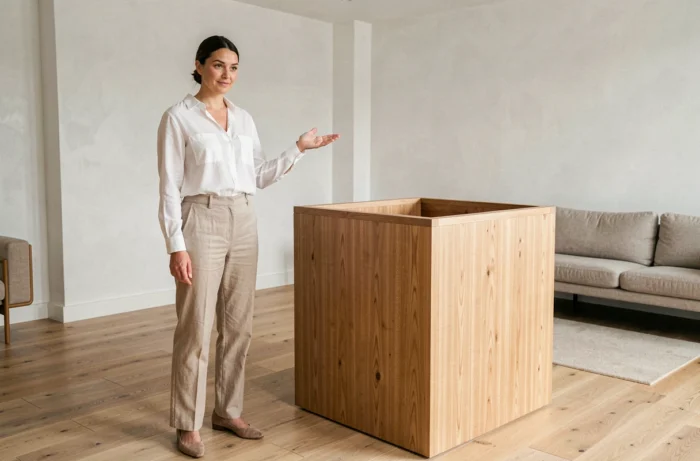
Three cubic meters is a figure you come across in a moving quote or on the sheet of a storage box. The problem is that no one walks around with a three-meter ruler in their pocket. Visualizing this volume in a real space requires some concrete references, and optimizing them changes everything when every centimeter counts.
Everyday references to visualize 3 m³
You have probably seen a standard refrigerator-freezer, the one that sits in most kitchens? Its exterior volume is around 0.7 to 0.9 m³ depending on the models. Three cubic meters is about three to four stacked refrigerators.
Another reference: a double bed (mattress, box spring, and frame) occupies between 1 and 1.5 m³ by itself. Add a dresser and two boxes of books, and you reach 3 m³. It’s neither a whole studio nor just a simple travel bag, but an intermediate volume that corresponds to the contents of a modestly furnished room.
When trying to understand what a volume of 3 m³ represents, the best method is to think in familiar objects rather than abstract formulas. A perfect cube of 3 m³ would measure about 1.44 m on each side, which is roughly the height of a ten-year-old child. It’s not very big.
Calculating the volume of your furniture without mistakes
The formula is simple: length multiplied by width multiplied by height, all in meters. A two-seater sofa measuring 1.60 m long, 0.85 m deep, and 0.80 m high represents about 1.08 m³. With just one piece of furniture, you already consume a third of the available 3 m³.
The common trap is to measure only the furniture and forget everything else. Boxes, bags, and loose items take up space that is systematically underestimated. A standard moving box (about 0.06 m³ each) seems modest, but ten boxes already represent 0.6 m³.
The safety margin rule
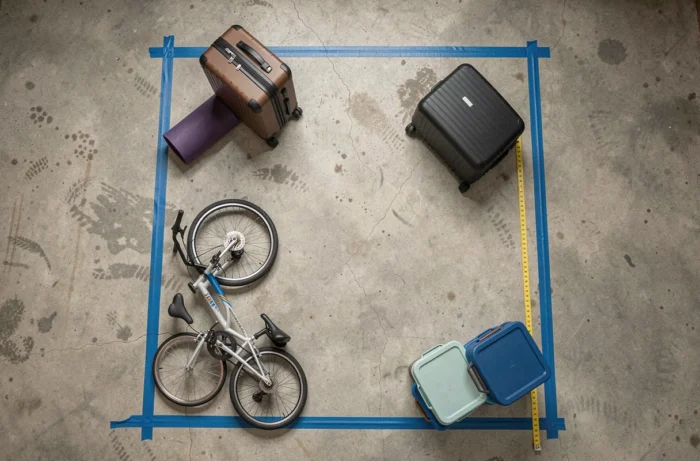
Always add a margin of 10 to 15% to the calculated volume. Irregular shapes (floor lamp, vacuum cleaner, bicycle) create dead spaces that are impossible to fill. Without this margin, you risk exceeding your actual space even though your estimate seemed correct on paper.
For a quick estimate without measuring everything, there is a method: dividing the living area by two gives an approximation of the total volume in cubic meters for a traditionally furnished home. A studio of 20 m² therefore contains about 10 m³ of goods. If you are only moving part of your belongings, apply this rule to the relevant room.
Storage box and truck: choosing the right size for 3 m³
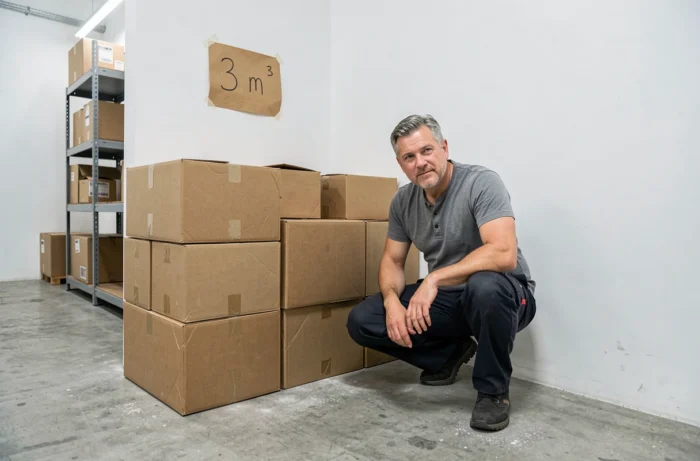
In the self-storage market, a volume of 3 m³ generally corresponds to a small box of about 1 to 2 m² of floor space, depending on the ceiling height. These micro-boxes are multiplying in large cities, integrated directly into existing buildings (parking lots, vacant spaces). They are designed for ultra-compact storage: archives, seasonal equipment, personal belongings between two homes.
On the truck side, 3 m³ represents a fraction of a standard utility vehicle. A small van like a Kangoo or Berlingo offers a useful volume of about 3 to 4 m³. In other words, one trip in a van is enough to transport 3 m³, provided you organize the loading well.
Box or van: the right choice depending on duration
- For storage of a few weeks to several months, a nearby box remains the most practical solution. You can access it whenever you want, without needing a vehicle.
- For a one-time move (relocation, delivery), renting a van for half a day is cheaper than a month of box rental. The determining factor is the duration.
- For a mixed need (transport then temporary storage), some providers combine both services. Make sure that the size of the box corresponds to the calculated volume, not just the advertised surface area.
Optimizing the filling of 3 m³: concrete techniques
A well-filled volume of 3 m³ can hold twice as many items as an identical volume loaded hastily. The difference lies in a few simple principles.
Start with heavy and rectangular objects at the bottom. Boxes of books, full drawers, and flat items (table tops, mirrors) form a stable base. Then, stack the boxes from largest to smallest, filling each gap with linen, cushions, or soft bags.
What wastes the most space
Unassembled hollow objects are the worst enemies of a small volume. An unassembled armchair occupies almost 1 m³ due to its shape. Remove the legs, nest the elements into each other. Everything that can be disassembled should be disassembled, including shelves and bed frames.
Half-filled boxes are also problematic. They cannot support the weight of a box placed on top and create lost spaces in height. Fill each box to the top, even if you have to pack it with paper.
- Dismantle furniture with legs, shelves, and modular structures before loading them.
- Slide soft items (clothes, duvets, towels) into residual spaces rather than into dedicated boxes.
- Place fragile items in the center of the volume, protected by more robust elements on the sides and underneath.
With 3 m³, the margin for error is small. Poor arrangement forces you to rent additional space or make a second trip. Taking twenty minutes to plan the loading before starting avoids this kind of extra cost. The volume doesn’t change, but the filling method determines what really fits.