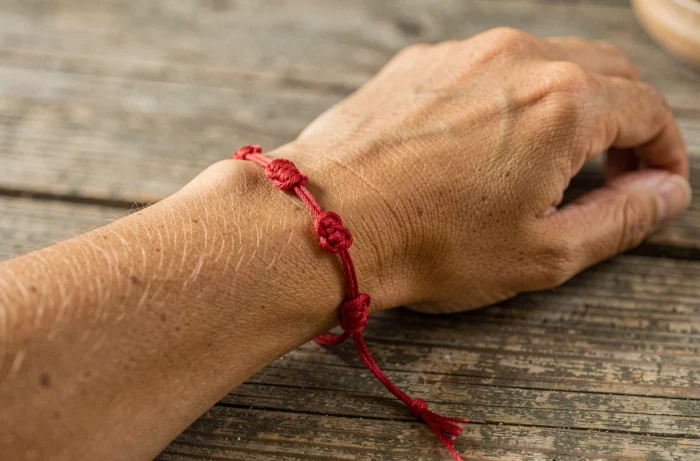
The red thread bracelet with 7 knots is not just a textile accessory. Each knot serves as an energetic anchor point, and the red thread acts as a protective conductor according to traditions that span Kabbalah, Tibetan Buddhism, and Afro-Brazilian syncretic cults. Understanding this symbolic mechanism allows one to distinguish a structured ritual from a decorative gesture.
Azo dyes and GPSR regulation: what no one checks before purchase
A red thread bracelet sold in the European Union is now subject to the Regulation (EU) 2023/988 on the general safety of products (GPSR). This text requires sellers, including on marketplaces, to provide technical documentation and a European contact point for any textile accessory placed on the market.
The issue of dyes is central. Cheap red-dyed threads sometimes use azo dyes that may release aromatic amines classified as carcinogenic. The REACH regulation strictly governs these substances. We recommend checking that the thread is certified compliant (REACH mention or Oeko-Tex label) before any purchase, especially for bracelets imported from outside the EU.
This regulatory point directly concerns the symbolism of protection: wearing a bracelet meant to protect against negative energies while ignoring the chemical composition of the thread creates a concrete contradiction. A thread made of organic cotton or virgin wool dyed with plant pigments remains the most coherent choice.

Hybrid ritual: why the 7-knot red thread bracelet is no longer tied to a single tradition
In recent years, the practice of tying a red thread with seven knots has seen a marked resurgence, particularly around periods of personal transition (career change, breakup, new moon, New Year). What distinguishes this recent wave is its assumed syncretic character.
The red thread draws simultaneously from Kabbalah (protection against the evil eye, left wrist), Tibetan Buddhism (blessing by a monk, recitation of mantras), and Afro-Brazilian cults or popular Latin American Catholicism (link with protection against “mal de ojo”). We observe that current practitioners no longer claim a single tradition: they compose a personal ritual by borrowing from multiple sources.
To delve deeper into the meaning of the 7-knot red thread bracelet, one must accept this dimension of cultural mixing rather than seek a monolithic origin.
This hybridization does not weaken the ritual. It reflects a pragmatic approach where the intention placed on each knot takes precedence over doctrinal belonging. The red thread becomes a neutral support that each wearer charges according to their own frame of reference.
Seven knots, seven intentions: the symbolic mechanics of tying
The number seven is not arbitrary. It appears in Kabbalah (seven days of creation, seven lower divine attributes called sefirot), in Buddhism (seven factors of enlightenment), and in many folk traditions. Each knot of the bracelet corresponds to a distinct intention, not a vague wish.
The difference between intention and wish is technical. A wish (“I want to be happy”) remains passive. An intention (“I commit to setting a clear boundary in my professional relationship”) involves action. We recommend articulating each intention aloud at the moment of tying, associating a slow breath with each knot.
Here are the areas that the seven knots traditionally cover:
- Protection against the evil eye: the first knot neutralizes negative looks and thoughts directed at the wearer
- Love and emotional bonds: the second knot strengthens sincere relationships and distances toxic ties
- Health and vitality: the third knot channels vital energy into the body
- Luck and opportunities: the fourth knot opens a space of receptivity to favorable occasions
- Inner serenity: the fifth knot anchors calm in stressful situations
- Happiness and gratitude: the sixth knot establishes a positive disposition in daily life
- Spiritual connection: the seventh knot links the wearer to their personal symbolic dimension, regardless of their tradition
The order may vary according to schools. What remains constant is the principle of one intention per knot, formulated specifically.
Left wrist or right wrist: a choice that depends on tradition
In Kabbalah and popular Christianity, the red thread bracelet is worn on the left wrist, considered the receptive side of the body (the one through which external energies enter). In Hinduism, the right wrist is preferred, associated with action and giving.
Tibetan Buddhism does not set a strict rule regarding the wrist. The choice then depends on the dominant intention: reception and protection on the left, action and projection on the right.
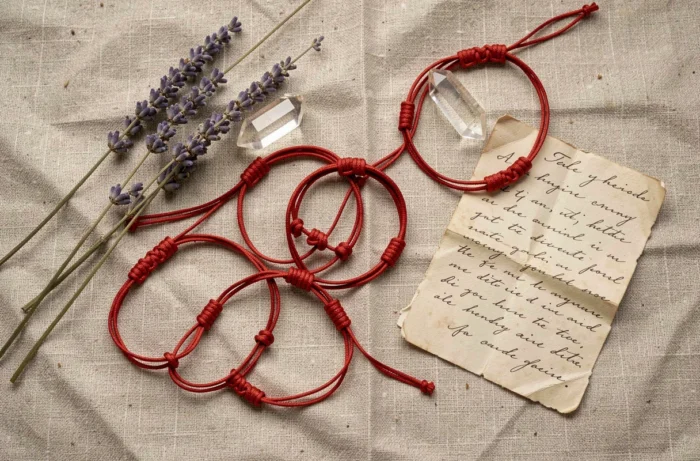
Purification and activation of the red thread: concrete protocol
A new red thread bracelet carries the residual energies of its manufacturing and transport. Purification is a prerequisite step before intentional tying.
The fumigation with white sage or palo santo remains the most suitable method. The textile thread absorbs moisture, making immersion in saltwater problematic: salt weakens the fibers, alters the integrity of the knots, and may discolor the red. We strongly advise against soaking for a cotton or wool bracelet.
The fumigation protocol is simple: light the stick, let the flame extinguish, then pass the bracelet through the smoke for one to two minutes while slowly rotating it. Activation follows immediately: tie each knot while stating the corresponding intention, ideally with a trusted person who ties it on your wrist.
When to replace a worn red thread bracelet
A thread that breaks naturally is not a bad sign. In most traditions, the breakage means that the bracelet has absorbed what it needed to absorb. The protection cycle is considered complete. The worn thread is not re-tied: it is replaced with a new bracelet, with new intentions suited to the current life period.
The lifespan varies according to the quality of the thread and exposure to water or friction. A waxed cotton thread withstands better than a wool thread, but the choice of material also depends on the tradition followed (Kabbalah favors red wool).
The 7-knot red thread bracelet remains an object whose value lies entirely in the rigor of the ritual and the quality of the material. Checking the regulatory compliance of the thread, formulating precise intentions, and respecting the purification protocol transforms a simple cord into a structured symbolic support.