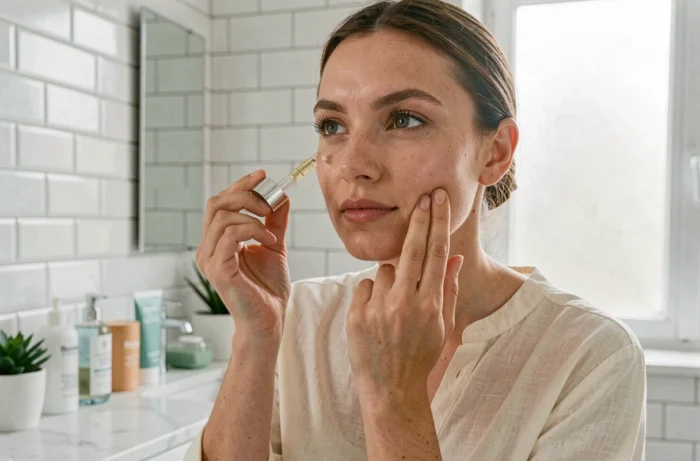
When you enter a French pharmacy today, the dermo-cosmetic shelf space has doubled compared to what we saw a few years ago. Brands of face care, sun care, and nutricosmetics are taking up meters of shelf space previously occupied by over-the-counter medications. This shift reflects a quantified reality: the beauty market in France is growing in value but declining in volume. We are buying fewer products, but we are choosing more expensive and targeted ones.
Dermo-cosmetics in pharmacies: the channel reshuffling the beauty market
The “pharmacy first” reflex has taken hold among a growing segment of French consumers. Sell-out data shows a more than 8% increase in dermo-cosmetic sales in pharmacies over the past year, amounting to nearly 68 million euros more. This is not a story of low prices: it is product innovation that drives growth, not promotions.
The sun care segment illustrates this dynamic well. It is nearing 230 million euros in sales with a growth of over 22% in one year. Stick formats, practical and portable, are up by 19%. We are far from the tube of sunscreen forgotten at the bottom of a beach bag: sun care is becoming a daily gesture integrated into face care routines.
This rise of pharmacies as a full-fledged beauty channel is regularly reflected in the news on Annuaire Beauté, where dermo-cosmetic launches are taking an increasingly prominent place compared to releases in selective perfumeries.
Organic cosmetics in France: a real segment but statistically blurry
There is a lot of talk about natural and clean beauty. On the ground, the reality of certified organic in French cosmetics is more nuanced. The segment accounts for about 572 million euros, which represents barely 6% of the total market. This is significant, but certified organic remains a niche segment in a market dominated by conventional dermo-cosmetics.
The main problem remains a statistical blind spot on organic cosmetics. Definitions vary according to labels (Cosmos, Ecocert, Nature & Progrès), distribution channels are not all audited in the same way, and “natural” products without certification blur the lines. For consumers looking for environmentally friendly products, reading labels remains the only reliable filter.
“Natural” claim on a cosmetic product: what it really guarantees
A product can claim “97% of ingredients of natural origin” without any organic certification. European regulations govern claims, but there is no legal threshold defining the term “natural” in cosmetics. Brands that prioritize transparency publish their complete INCI lists and specify the origin of each active ingredient. Others settle for green packaging and a stylized leaf.
European regulations on cosmetic substances: what is changing concretely
The tightening of European regulations on chemical substances directly impacts formulations. Restrictions on endocrine disruptors and PFAS (per- and polyfluoroalkyl substances) force manufacturers to reformulate, sometimes urgently. The regulation on BPA (bisphenol A), originally intended for food, already applies to cosmetic packaging.
For French brands, this translates into several operational constraints:
- Reformulation of products containing UV filters or preservatives classified as CMR (carcinogenic, mutagenic, reprotoxic), with a tightening timeline
- Adaptation of packaging to comply with restrictions on substances migrating from packaging to the product
- Updating product information files (DIP) to incorporate new safety assessments required by European cosmetic regulations
These adjustments are costly. Returns on this point vary depending on the size of the companies, but small independent brands are the most exposed, lacking dedicated regulatory services. Regulatory compliance is becoming a competitive advantage for those who anticipate it.
Premiumization of care and decline in volumes: what purchasing behavior reveals
The French beauty market is growing in value but declining in volume. This gap tells a deep story: consumers are concentrating their budgets on fewer products, but better chosen. We no longer stack serum, essence, ampoule, and cream. We select two or three treatments with concentrated actives.
This premiumization affects all distribution channels, from pharmacies to selective perfumeries. The brands that are succeeding are those that justify their prices through active concentration, ingredient traceability, or clinical proof of efficacy. The “luxury by image” discourse without product substance is losing ground to brands that document their results.
In-demand cosmetic actives: what is rising in 2026
Peptide-based serums, topical probiotic-enriched treatments, and formulas combining sun protection and anti-aging are capturing attention. The common point: actives whose efficacy is measurable on the skin, not just claimed. Consumers compare concentration percentages, read clinical studies when published, and are no longer hesitant to abandon a brand that does not document its promises.
The French beauty sector is going through a phase where the quality of information is as important as the quality of the product. Brands that publish their data, reformulate ahead of regulations, and maintain prices consistent with their formulations gain a competitive edge. Those that do not document their formulations or their proof of efficacy are losing ground to consumers who verify before buying.