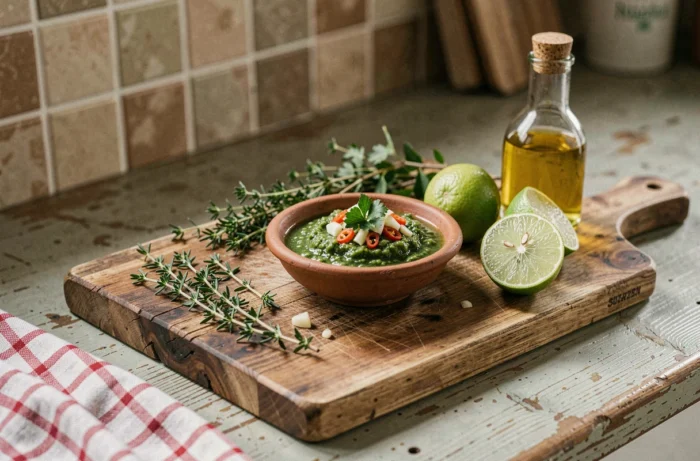
The sauce chien has accompanied grilled dishes in the Caribbean for generations. Its name, which often surprises visitors passing through Martinique or Guadeloupe, has nothing to do with the animal. This preparation made from fresh herbs, chili, and lime hides a story linked to a common Creole object and nutritional properties that deserve attention.
The chien knife, a Creole utensil behind the sauce’s name
Have you ever noticed that some dishes are named after the tool used to prepare them? This is exactly the case here. The sauce chien gets its name from a very popular folding knife in the French Caribbean: the chien knife, originally made by the Sabatier Frères et fils cutlery, and later taken over by Thiers Issard in Thiers.
This recognizable knife features an engraving of a dog on its blade, just in front of the guard. For a long time, every Caribbean family owned one. It was even traditionally given as a wedding gift.
Creole cooks used it to finely chop the herbs, chili, and onions needed for the sauce. By habit, the preparation took the name of the tool. By exploring the origin of the appetizing sauce chien, we better understand why this recipe remains inseparable from Guadeloupean and Martiniquan culinary culture.
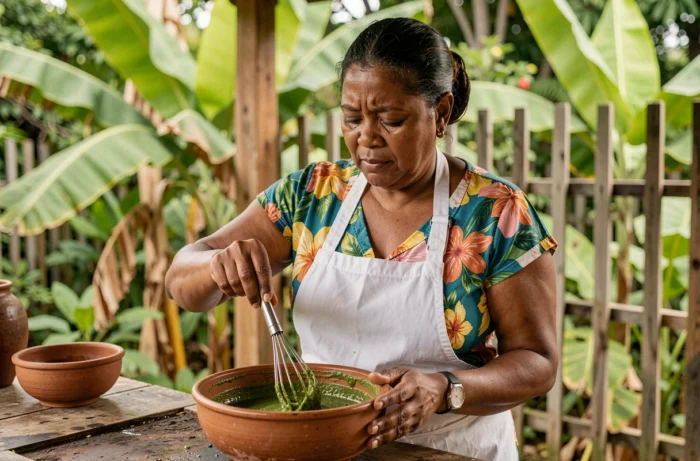
Composition of sauce chien: fresh ingredients with concrete virtues
The traditional recipe relies on a simple assembly. No long cooking, no elaborate sauce base. Everything hinges on the freshness of the herbs and the quality of each component.
The basic elements
- Flat-leaf parsley and local onions (or chives) form the aromatic base, finely chopped with the knife
- Lime provides the characteristic acidity, while garlic enhances the flavor
- Caribbean chili (often vegetarian chili or hot chili depending on taste) adds the spiciness, adjusted to personal preference
- Vegetable oil and boiling water poured over the mixture help release the aromas without cooking the herbs
This hot water poured at the last moment is what distinguishes sauce chien from a simple herb vinaigrette. It causes a quick infusion that releases the aromatic oils from the parsley and chives without destroying them.
A nutritional profile supported by herbs and chili
Parsley is one of the herbs richest in vitamin C and antioxidants among common herbs. Garlic, for its part, is studied for its sulfur compounds. Lime complements the vitamin C intake.
The absence of cream, butter, or added sugar makes this sauce a light accompaniment. Compared to a béarnaise or an industrial barbecue sauce, sauce chien has a much more modest profile in fats and calories.
Capsaicin from chili: what research observes on health
The chili used in sauce chien contains capsaicin, the molecule responsible for the sensation of heat in the mouth. Competing articles mention the “spicy” aspect of the sauce but stop there. Recent scientific studies go further.
A review published by Wiley, compiling several meta-analyses and systematic reviews, indicates that capsaicin may promote the balance of the gut microbiota and reduce certain forms of mild inflammation in the digestive tract.
Associations have also been observed between regular consumption of spicy foods and certain favorable metabolic markers. However, these results remain statistical associations, not direct evidence of causality.
The overall quality of evidence remains moderate according to the same review. In other words, incorporating chili into one’s diet through homemade sauce chien is consistent with protective cooking, but it is not a miracle remedy.
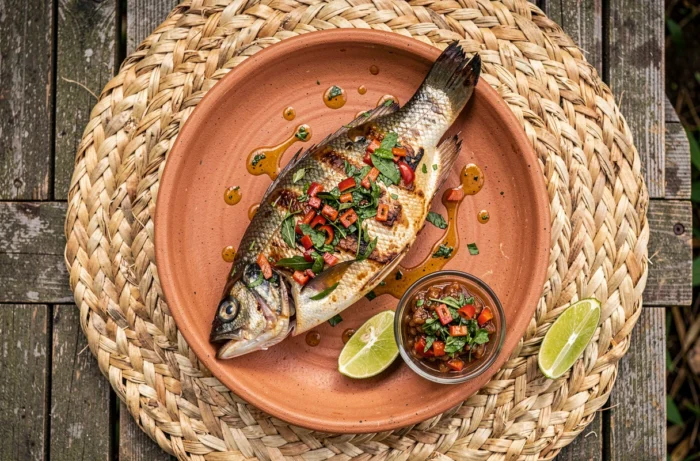
Sauce chien and daily diet: when and how to use it
In the Caribbean, sauce chien primarily accompanies grilled fish, smoked chicken, and lobster. Its role is to enhance without masking. A fillet of snapper cooked on the barbecue takes on a whole new dimension with a spoonful of freshly prepared sauce chien.
Outside of Creole cuisine, this sauce adapts to many contexts. It works well on grilled vegetables, as a quick marinade for shrimp, or simply as a condiment on plain rice.
An asset for diversifying seasonings
Why does this sauce deserve a regular place in your kitchen? Because it effectively replaces industrial sauces often loaded with salt, sugar, and additives. Preparing your sauce chien takes about ten minutes and requires no special technical skills.
The only point of caution concerns the dosage of chili. For those sensitive at the digestive level, it is better to start with vegetarian chili (mild) and adjust gradually.
Storage and freshness
Ideally, sauce chien should be consumed on the same day. Fresh herbs quickly lose their aromatic brilliance once chopped and infused. In the refrigerator, it keeps for one to two days, but the best flavor is found in the first hours after preparation.
Sauce chien exemplifies a culinary approach where the simplicity of ingredients produces an intense result. Its history, linked to a French cutlery knife adopted by Creole families, gives it an identity that few sauces can claim. From a health perspective, its fresh components and the absence of industrial processing make it a seasoning compatible with a balanced diet, without attributing miraculous powers to it.