
The systemic approach applied to healthcare professionals is not limited to family therapy transposed into a hospital setting. It restructures the very reading of organizational dysfunctions, repositioning the caregiver as an element of a system whose interactions produce, maintain, or resolve the difficulties encountered on a daily basis.
Systemic Reading of Professional Burnout in Healthcare
The burnout of caregivers is not a failure of individual resilience. Recent analyses position it as the direct result of environments where chronic stress factors are not managed at the organizational level. Administrative flows, loss of clinical autonomy, information overload: the system produces the symptom, not the professional.
This framework radically changes the level of intervention. Instead of proposing stress management workshops (an individual-centered approach), systemic support identifies the feedback loops that maintain suffering: a poorly calibrated transmission meeting generates errors, which increase the control burden, which extends working hours, which fuels resentment. Addressing a single link does not bring about lasting change.
European data confirms this reading. Between one-tenth and one-third of healthcare professionals surveyed in certain European countries are actively considering resigning mid-career. This phenomenon is directly correlated to the design of work, not to the level of remuneration or initial vocation. The systemic approach, by mapping the interactions between positions, processes, and managerial decisions, provides an intervention framework that traditional quality of life at work measures do not cover.
Organizations specialized in the systemic support of healthcare teams structure this approach, as can be seen on https://virages-sante.fr/, which articulates training and intervention with institutions.
Systemic Intervention and Patient Safety: A Paradigm Shift

Patient safety has long relied on the analysis of individual errors. The systemic approach reverses this logic: the error is a signal from the system, not a fault of the operator. This principle, already applied in aviation and the nuclear industry, is beginning to structure the continuing education of caregivers.
An inter-university diploma “Patient Safety: Organizational and Human Factors,” offered starting in 2026 across six modules totaling ninety hours, explicitly integrates safety culture, interprofessional communication, and systemic analysis of adverse events. This type of training marks a turning point: caregivers are no longer trained to “be careful,” but are equipped to read the organizational dynamics that produce risk.
We observe that institutions adopting this framework reduce the use of disciplinary procedures after incidents and increase voluntary reporting of adverse events. The punitive logic hinders feedback. The systemic vision frees up discussion about errors by disconnecting it from individual guilt.
What the Linear Model Misses
The classic model presents a simple chain: error, cause, responsible party, correction. The systemic model presents a network: organizational context, time pressures, quality of team communication, protocol design, cumulative fatigue. Intervening on a single factor without considering its interactions with others produces displacement effects, where the problem migrates to another link.
Systemic Training of Healthcare Teams: Methods and Points of Vigilance
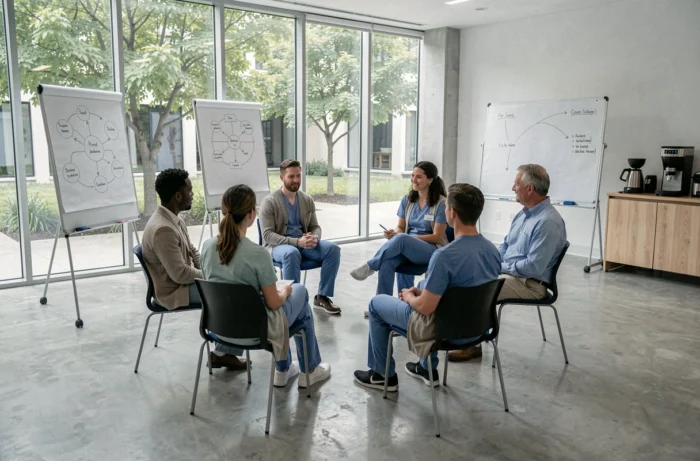
Training healthcare professionals in systemic thinking does not consist of teaching them the Palo Alto theory in a lecture hall. The challenge is to change their observation and intervention posture within their own work system.
Formats that produce measurable results share several characteristics:
- Work on the real interactions of the team, not on fictitious cases. Participants map their own communication loops, identify repetitive patterns, and test concrete modifications between sessions.
- A sufficient duration to observe second-order effects. Short training sessions (one day) raise awareness but do not change relational patterns. Support spread over several months, with intersession analysis times, allows the system to reorganize.
- Involvement of management and leadership. A team trained in systemic reading that returns to a linear managerial environment quickly loses its gains. Change must touch multiple hierarchical levels simultaneously.
Some programs now combine the systemic approach with other clinical tools (therapeutic mediations, strategic communication techniques) to enrich the intervention palette. This hybridization avoids the pitfall of a single model mechanically applied to very different contexts.
Limits and Conditions for Success of the Systemic Approach in Health
The systemic approach is not a universal solution. Its effectiveness depends on structural conditions that we recommend evaluating before any intervention.
The system must accept to be observed as a system. In highly hierarchical organizations, mapping interactions can be perceived as a challenge to authority. Without explicit commitment from governance, systemic intervention faces resistances that neutralize it.
Timing poses another problem. Healthcare institutions operate under pressure for immediate results. However, systemic change produces its effects with a time lag. The first months may even see an apparent increase in tensions, as the system makes visible dysfunctions that were previously masked by avoidance strategies.
Systemic support for healthcare professionals gains legitimacy because it addresses a shared observation: individual solutions have reached their ceiling of effectiveness. The next step involves integrating this approach into the initial training curricula of healthcare professions, not just in continuing education.