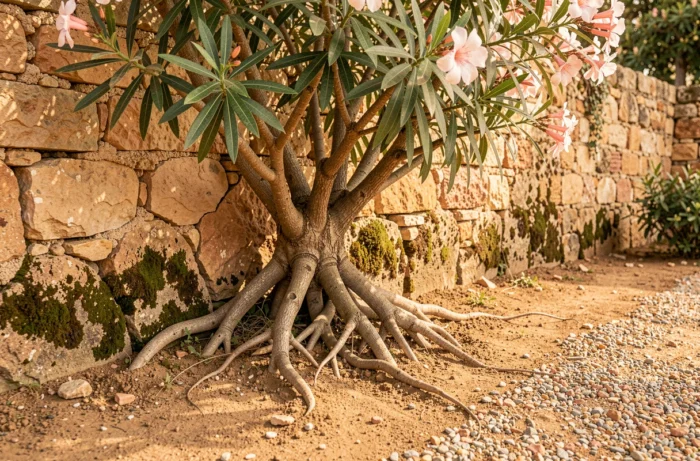
The oleander is a Mediterranean shrub prized for its flowering hedges, often planted near facades. The question of the risk its roots pose to a house wall comes up regularly. To answer this, it is necessary to distinguish between two very different mechanisms: the direct mechanical pressure of the roots on the masonry, and the drying of the soil caused by the plant’s water consumption. The available data shows that these two risks are not equal at all.
Mechanical risk versus drying risk: comparison of the two mechanisms
| Criterion | Mechanical pressure of the roots | Soil drying (shrink-swell of clays) |
|---|---|---|
| Type of roots involved | Fasciculate, fibrous roots | Any root absorbing water in clayey areas |
| Ability to crack a healthy wall | Very low | Real on clay soil |
| Most at-risk species | Poplar, willow, fig, running bamboo | Any persistent vegetation with high water demand |
| Presence of oleander in lists of problematic species | Absent | Cited as an aggravating factor in clayey areas |
| Trends in claims in France | Stable | Increasing since the last dry summers |
This table summarizes the gap between the most widespread fear (roots pushing a wall) and the real risk, which is less visible but better documented. The oleander is not among the species reported for their root power by risk synthesis documents relayed by the specialized press citing Géorisques.gouv.fr. On the other hand, its presence in a persistent hedge near a facade on clay soil exacerbates the phenomenon of shrink-swell of clays, a structural disaster that is on the rise.
Understanding the issue of oleander roots near a wall requires moving beyond the image of the root that lifts the stone. The true discriminating factor is the nature of the soil.
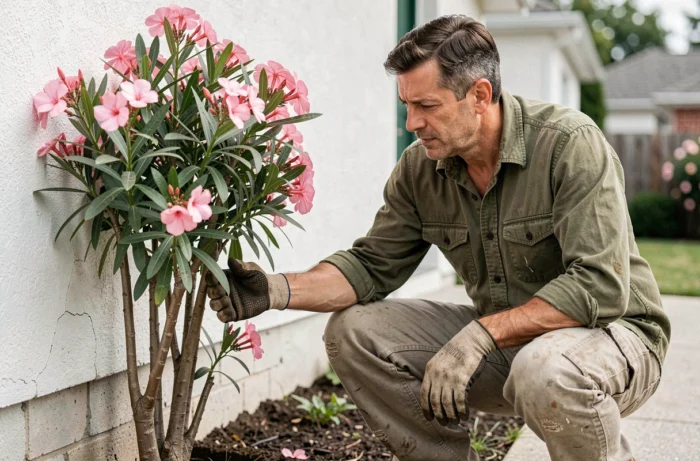
Clay soil and oleander: why RGA changes everything
Shrink-swell of clays (RGA) is a simple geological phenomenon: a clayey soil swells when it is wet and shrinks when it dries. This movement creates tensions on the foundations, which manifest as cracks in the facade. Nearby vegetation amplifies the summer drying of the soil by pumping the available water around the foundations.
Crack experts and home insurers in France have been emphasizing the role of RGA as a determining cause of facade cracks for several years, more so than the direct mechanical pressure of the roots. Recent recommendations advise against any persistent hedge against the house and favor, within five meters of the walls, dwarf shrubs and perennials with low root development.
The oleander, with its persistent foliage and significant water consumption in summer, falls into this category to watch. On well-drained sandy or limestone soil, the risk remains very low. On clay soil, the proximity of a dense hedge of oleanders can accentuate the moisture differential between the shaded area by the hedge and the rest of the land, creating a localized drying around the foundations.
How to know if your land is affected
The mapping of RGA exposure is accessible on Géorisques.gouv.fr. Three levels of exposure are defined there. If your plot is classified as medium or high exposure, the planting distance and choice of plants near the walls deserve special attention.
- Consult the RGA exposure map on Géorisques.gouv.fr by entering the address of the plot
- Check the level of exposure: low, medium, or high
- In medium or high exposure, apply a wider planting distance than generic recommendations and consider a root barrier or container gardening
Planting distance for oleander and protection of buried networks
The minimum distance often cited by gardeners is around one to two meters from the wall. This recommendation applies to stable soil and sound foundations. On clay soil, several sources recommend extending this distance to beyond three meters, even five meters for dense hedges.
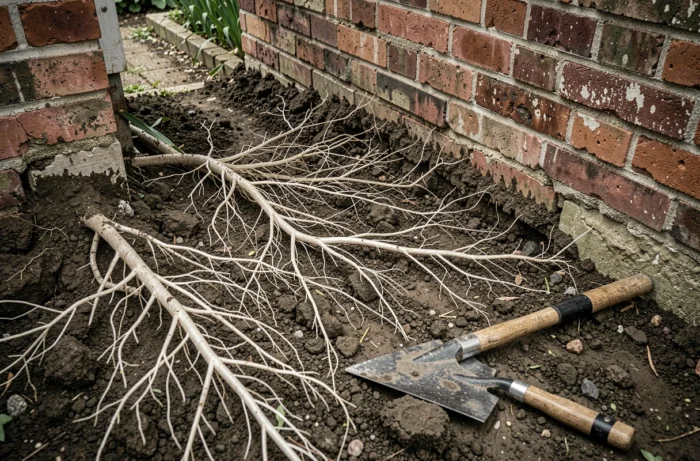
Old pipelines remain the real weak point. The oleander does not break a pipe in good condition. However, its roots can infiltrate an existing micro-leak (defective joint, poorly made connection) and worsen the problem over the years. This phenomenon is well documented by unblocking professionals, who report that the attraction of roots to a source of moisture can occur even when the pipeline is buried more than three meters deep.
Elements to check before planting
- Locate buried pipelines (water, sanitation) and maintain a sufficient distance from their path
- Check the condition of joints and connections if the pipelines are over twenty years old
- Install a root barrier between the shrub and the networks if the minimum distance cannot be respected
- Prefer container gardening against the wall if the soil is clayey and space is limited
Oleander in a pot against a wall: alternative or compromise
Planting in a large container eliminates the risk of interaction between the roots and the foundations or pipelines. The oleander tolerates container gardening well, provided the volume is sufficient (at least a hundred liters for an adult plant) and that drainage is adequate.
In a pot, the oleander poses no risk to a wall. The compromise lies in vigor: a potted subject rarely reaches the same height as in the ground, and its flowering depends on regular watering and fertilization. For a dense privacy hedge, the result will be less covering than in the ground.
On clay soil classified as high exposure to RGA, container gardening remains the most reliable solution to keep an oleander against the facade without exposing the structure to a disaster related to drying. The type of soil determines the planting method, not the plant itself. An oleander in the ground on sandy soil two meters from a wall will pose fewer problems than a subject in the ground four meters away on swelling clay. The nature of the land takes precedence over the raw distance.