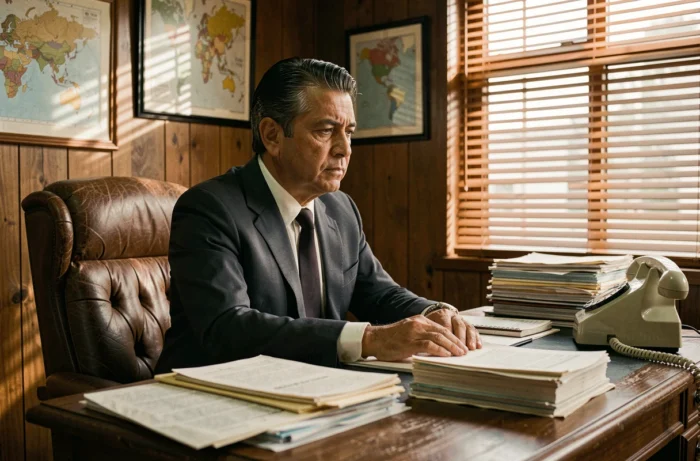
Miguel Ángel Félix Gallardo, born in 1946 in Culiacán, Sinaloa, built a drug trafficking network in less than two decades that was capable of controlling almost all of the Colombian cocaine transit to the United States. A former police officer turned bodyguard for a local governor, he structured the Guadalajara cartel around an unprecedented model: the “plazas,” territories assigned to lieutenants responsible for managing each trafficking corridor.
His arrest in 1989, linked to the assassination of DEA agent Enrique “Kiki” Camarena, marked the end of an era and the beginning of a fragmentation whose consequences Mexico still endures.
The plaza system: an unprecedented drug trafficking logistics in Mexico
What distinguishes Félix Gallardo from the Mexican traffickers who preceded him is less the volume of drugs moved than the organizational architecture he established. The plaza system operated like a criminal franchise. Each plaza corresponded to a border crossing point or a production area, entrusted to a local operator who paid a share to the Guadalajara cartel.
This model helped limit territorial conflicts, as each lieutenant had their own perimeter. It was a flexible centralization, where Félix Gallardo arbitrated disputes and coordinated relationships with Colombian suppliers.
To understand who Miguel Angel was in Mexico, one must grasp this role of architect rather than mere baron. He did not control drugs through brute force, but through the management of flows and alliances.
Police officer, bodyguard, trafficker: the bridges between the state and the Guadalajara cartel
Félix Gallardo’s journey illustrates a structural porosity between Mexican institutions and drug trafficking. Recruited as a police officer in Sinaloa, he became the trusted man of the local governor in the 1960s. At that time, he collected bribes from the underworld on behalf of political leaders.
This shift from public service to organized crime was not exceptional in the context of Sinaloa in the 1960s-1970s. The boundary between state protection and trafficking protection was porous, and officials who mingled with narcos regularly ended up crossing over.
Operation Condor: an unintentional accelerator
In the mid-1970s, Operation Condor, jointly conducted by Mexico and the United States against drug crops in Sinaloa, paradoxically strengthened Félix Gallardo’s position. By displacing traffickers from their historical stronghold, this military offensive pushed several figures of drug trafficking towards Guadalajara.
- Rafael Caro Quintero, a large-scale marijuana specialist, settled there and joined Félix Gallardo’s organization.
- Ernesto Fonseca Carrillo, known as “Don Neto,” a veteran of Sinaloan trafficking, became one of his main associates.
- The regrouping in Guadalajara allowed for the centralization of Colombian cocaine routes to the United States, in addition to traditional marijuana and heroin channels.
The operation intended to destroy drug trafficking thus contributed to creating a more structured and powerful cartel than anything that existed before.
The Camarena case and the fall of the Mexican godfather
The kidnapping, torture, and murder of DEA agent Enrique “Kiki” Camarena in 1985 marked a turning point. Camarena was investigating the marijuana plantations of the Guadalajara cartel. His disappearance triggered a major diplomatic crisis between Mexico and the United States.
The assassination of Camarena made the political protection of the cartel untenable. As long as trafficking remained a Mexican affair, authorities could turn a blind eye. The direct involvement in the murder of an American agent changed the game. The pressure from Washington became too strong for the usual corruption networks to function.
Félix Gallardo initially tried to reorganize his empire. In 1989, during a meeting that went down in the annals of drug trafficking, he reportedly redistributed the plazas among his lieutenants, anticipating his arrest. Among the beneficiaries of this sharing were the future leaders of the Tijuana, Juárez, and Sinaloa cartels.
His arrest occurred the same year. The conviction of Félix Gallardo did not end trafficking; it multiplied it.
Post-Guadalajara fragmentation: the legacy that shaped modern cartels
The contemporary reading of Félix Gallardo’s role emphasizes less the man than what his fall engendered. The centralized and relatively stable Guadalajara cartel gave way to a mosaic of rival groups.
The previously coordinated plazas became independent strongholds. The rivalry between these new organizations generated the violence that has characterized Mexican drug trafficking since the 1990s. Félix Gallardo’s model contained conflicts; his disappearance unleashed them.
An old man under house arrest
After more than thirty years behind bars, Félix Gallardo was transferred to house arrest in 2022. This transfer was not the result of a judicial turnaround, but of the deterioration of his health and advanced age. As of 2026, he remains under judicial control, described by the few available sources as a physically diminished man.
The contrast between the former “Jefe de Jefes” and the elderly man under surveillance illustrates the classic trajectory of great drug lords: a meteoric rise, a brutal fall, followed by decades of erasure. The structures he created, however, have largely outlived him. Current Mexican drug trafficking remains organized according to territorial logics that find their direct origin in the plaza system invented in Guadalajara in the 1980s.