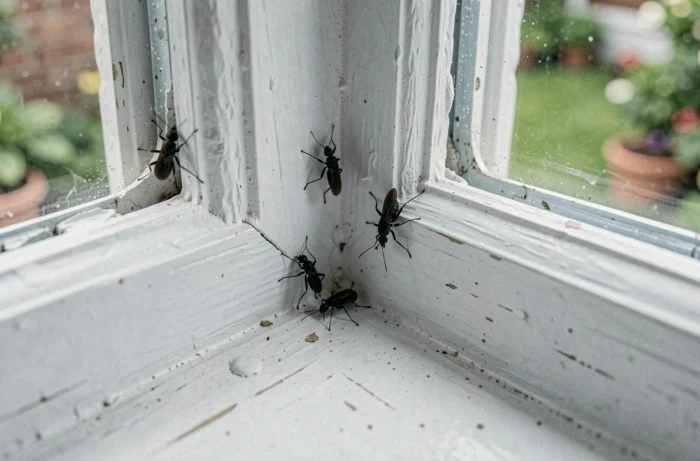
You regularly find tiny black insects on the ledge of your windows, along the joints, or on the curtains. Before looking for an insecticide, it’s important to understand what attracts them. In most cases, these little black creatures indicate a humidity problem in the home, not an invasion from outside.
The humidity gradient near windows, a true attraction factor
Windows concentrate two phenomena that insects love: condensation and light. When warm indoor air meets cold glass, water settles on the joints, the threshold, and the corners of the frame.
This residual humidity on window joints creates an ideal micro-habitat. Springtails, for example, need a film of water to breathe through their skin. They are not seeking the warmth of your living room, but the water that stagnates on the woodwork.
Psocids, another common sight on window sills, feed on microscopic mold. These molds develop where humidity persists. If you see them return after every rain episode, understanding why small black insects appear near windows allows you to address the cause rather than the symptom.
The common reflex is to spray a product on the ledge. The problem disappears for two days, then returns. As long as the source of humidity is not addressed, the insects will return.
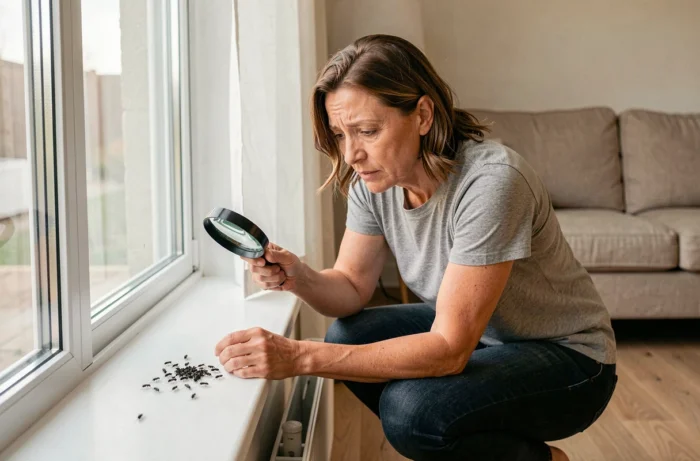
Springtails, psocids, and carpet beetles: three profiles to distinguish near windows
Identifying the insect changes the response to be provided. Three species can easily be confused on a window sill, but their needs differ.
Springtails: need water, not human food
Springtails measure less than two millimeters. They jump when touched thanks to an appendage folded under their abdomen. They are found in groups on damp surfaces, window sills, plant saucers, or bathtub edges.
Springtails do not bite and do not damage anything in the house. Their presence is a reliable indicator: the humidity level in the room is too high.
Psocids: the eaters of invisible mold
Even smaller, psocids look like tiny beige or dark gray dots. They move slowly on walls, books, and window frames. Their food is the mold that the human eye cannot yet see.
If you spot psocids, there is likely fungal development behind a baseboard, wallpaper, or within the thickness of aging silicone sealant.
Carpet beetles: a textile problem, not a humidity problem
The adult carpet beetle, a small black or brown beetle measuring two to five millimeters, flies towards windows attracted by light. This one is different. It does not seek humidity but a place to lay eggs. Its larvae feed on natural fibers: wool, silk, feathers.
Have you ever noticed small round holes in a sweater that has been stored for a long time? This is often the work of carpet beetle larvae, not moths. The adult itself causes no direct damage.
Check the real entry points in the home
A worn window seal lets in much more than air. Cracks around frames, unsealed conduit passages, and ventilation grilles without fine filters are all open doors.
- Inspect the silicone seals of each window. A darkened, cracked, or detached seal should be replaced, not covered.
- Check the roller shutter boxes. They often harbor condensation and organic debris that attract insects.
- Examine the saucers and potting soil of your indoor plants near the windows. Letting the surface of the potting soil dry between waterings significantly reduces the proliferation of fungus gnats.
- Run your hand along the baseboards under the windows. A feeling of cold or dampness indicates a sealing defect that needs to be addressed.
These checks take about twenty minutes and target the real causes. They are more effective than a blind chemical treatment.
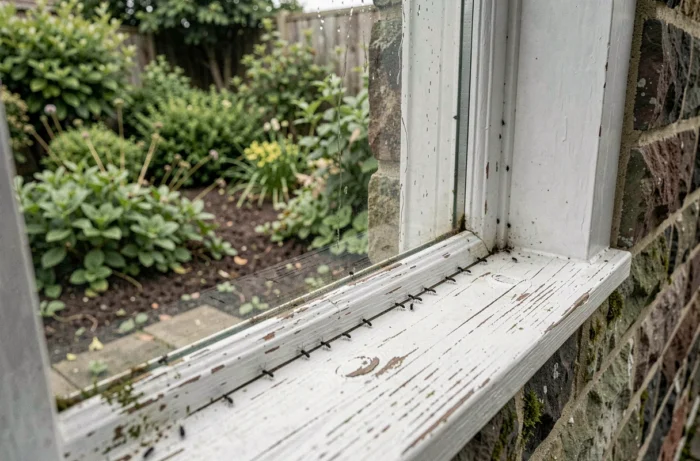
Lowering humidity to permanently eliminate small black insects
The common denominator for springtails, psocids, and fungus gnats is the available water. Reducing ambient humidity affects all these species at once.
Ventilate each room for at least ten minutes a day, even in winter. The controlled mechanical ventilation (CMV) should operate continuously. A clogged or turned-off CMV at night is enough to raise humidity levels above the comfortable threshold.
A well-ventilated home attracts few humidity-related insects. If insects persist despite proper ventilation, look for a hidden leak: under the sink, behind the washing machine, in the bathroom at the connections.
For carpet beetles, the logic is different. The vacuum cleaner remains the most effective tool. Vacuum in corners, under furniture, and along baseboards. Wash or expose to sunlight textiles that have been stored for a long time in a closed closet.
- Regularly vacuum hard-to-reach areas (under the bed, behind the dresser, bottom of curtains)
- Store natural fiber clothing in sealed covers
- Replace window seals as soon as they show signs of degradation
Preventing small black insects near windows relies on two actions: controlling humidity and maintaining the sealing of openings. When these two conditions are met, most of the affected species have no reason to settle in your home.