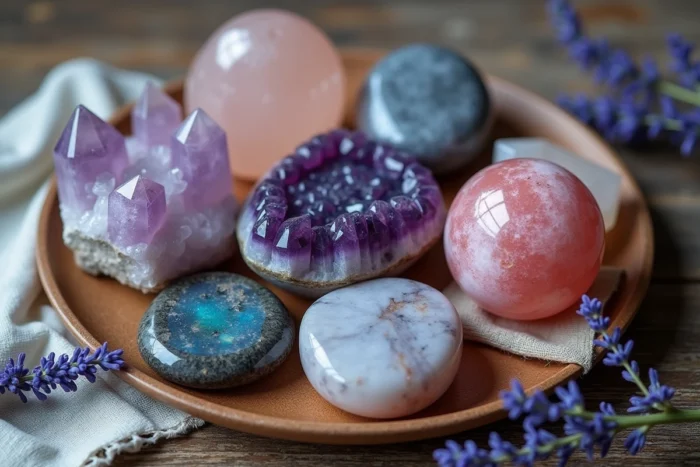
Natural stones are increasingly prominent in wellness practices related to stress management. Lithotherapy, which is based on the idea that certain minerals influence emotional and mental states, offers a wide range of stones with varied properties. Given this diversity, the choice of a stone to soothe anxiety benefits from a criterion often overlooked: the type of anxiety experienced.
Mental or emotional anxiety: a criterion for choosing your stones
Most online guides list anti-stress stones without distinction. Amethyst, rose quartz, howlite, black tourmaline: the same names keep coming up, presented as universal solutions. The problem is that anxiety does not manifest in the same way for everyone.
A person prone to mental ruminations and insomnia does not experience the same thing as someone facing sudden emotional outbursts or chronic physical tension. Recent specialized guides offer a more concrete sorting: amethyst would be more suitable for mental-type anxiety (racing thoughts, difficulty falling asleep), while lepidolite would better correspond to anxiety with an emotional or physical dominance (mood swings, tension in the body).
This type of distinction does not guarantee a result, but it provides a more coherent starting point than choosing a stone at random. To explore this profiling approach further, the list of stones by natacha-birds details the associations between minerals and types of anxiety.
Prehnite and lepidolite: foundational stones against chronic anxiety
Amethyst and rose quartz dominate the usual recommendations. Two other stones deserve special attention for those whose anxiety is long-lasting.
Lepidolite: a mica rich in natural lithium
Lepidolite is a mica that naturally contains lithium, an element used in psychiatry to stabilize mood. In lithotherapy, this stone is associated with a calming effect on intense nervous states and unstable emotional cycles. Its color ranges from pale pink to deep purple.
Field reports vary on the intensity of its effect, but its mineralogical composition objectively distinguishes it from quartz and silicates more commonly found in anti-stress lists.
Prehnite: dissolving long-term ruminations
Less known than classic stones, prehnite is increasingly cited for chronic anxiety. Described as capable of calming an agitated mind over the long term, it would work on mental fatigue related to persistent stress. Its translucent pale green hue makes it easy to identify.
For those whose anxiety is not limited to occasional episodes, these two foundational stones offer a complementary option to more well-known minerals.
Amethyst, rose quartz, tourmaline: what to reasonably expect
These three stones appear in nearly all lithotherapy guides. Their popularity is based on ancient traditions and numerous user feedback, not on clinical evidence.
- Amethyst: a variety of purple quartz, it is associated with mental calm, meditation, and better sleep. Placed on a bedside table or worn as a bracelet, it is the most recommended stone as a first choice.
- Rose quartz: a stone linked to soothing deep fears and emotional softness. Practitioners recommend it for people whose anxiety is accompanied by relational difficulties or a lack of self-confidence.
- Black tourmaline: used as a protective stone against negative energies. Its use mainly targets people who absorb stress from their environment (tense professional contexts, busy places).
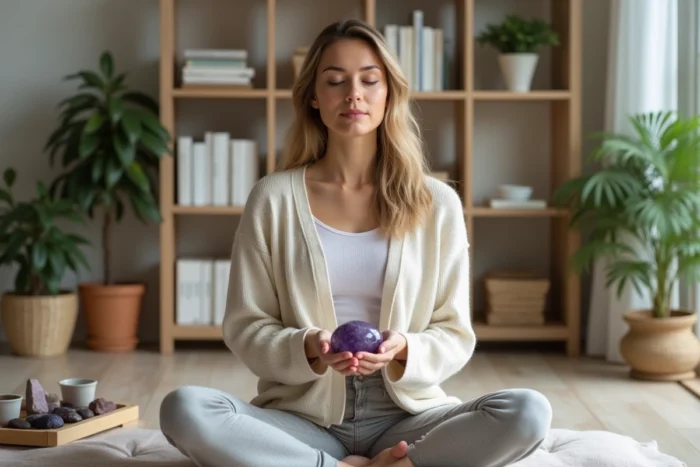
The available data do not allow for conclusions about a measurable mechanism of action for these minerals. However, the ritual and grounding effect they provide is documented by many wellness practitioners: handling a stone, wearing it, or meditating with it creates a calming routine in itself.
Choosing your anti-anxiety stone: practical criteria to consider
Beyond the type of stone, several concrete parameters guide the choice.
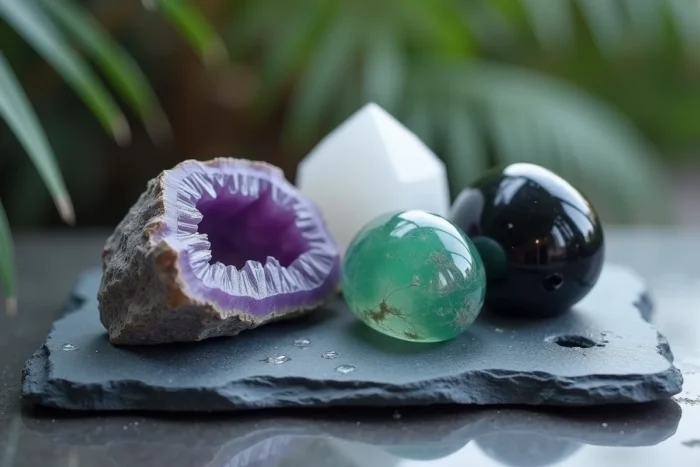
The form of use is as important as the mineral. A bracelet made of natural stones worn daily maintains prolonged contact with the skin, which corresponds to traditional use in lithotherapy. A tumbled stone slipped into a pocket serves a similar role. A geode placed in a room acts more on the ambiance of a living space.
The quality of the mineral also influences the experience. Artificially dyed or reconstituted stones made from mineral powder do not have the same crystalline structure as a raw or polished natural stone. Checking the origin and treatment of the stone with the seller remains a useful reflex.
- For ruminations and insomnia: amethyst, prehnite
- For emotional outbursts: lepidolite, rose quartz
- For anxiety related to the environment: black tourmaline, chalcedony
- For discreet daily use: bracelet or pocket tumbled stone
Chalcedony, often overlooked in main lists, is associated with soothing a tight throat and tensions related to communication, a common symptom of social anxiety.
Lithotherapy and anxiety: the limits to keep in mind
Lithotherapy does not have scientific recognition as a treatment for anxiety. No large-scale clinical study has demonstrated a pharmacological effect of natural stones on the nervous system. Stones do not replace medical follow-up or psychological support for characterized anxiety disorders.
Their interest lies more in the realm of personal ritual, meditation support, and transitional objects. Wearing a stone chosen with intention can structure a stress management routine, just like a breathing exercise or a gratitude journal. It is in this modest but real anchoring function that natural stones find their place.